The strongest I SPY Dress-Up inspiration from Walter Wick’s fantasy worlds is not a direct copy of a published scene. It is a way of thinking: objects can float, scale can mislead the eye, and a costume can behave like a small stage set. The exhibition I SPY! Walter Wick’s Hidden Wonders opened at the High Museum of Art in Atlanta on August 28, 2026, and runs through January 3, 2027. The museum describes the show as a retrospective survey of more than 45 works spanning 50 years, with photographs, early optical illusion work, and three-dimensional models connected to Wick’s images High Museum listing. For dress-up makers, that context matters because Wick’s work sits between photography, model-making, visual puzzles, and staged fantasy.
Why I SPY Dress-Up Starts With Set Thinking
A standard costume often begins with a character: cape, crown, tunic, mask. Wick’s fantasy photographs suggest another starting point. Begin with a set condition instead. Is the wearer trapped in a checkerboard room? Are toy-scale objects suddenly huge? Is the body partly framed by a miniature world? This shift is useful for patterns and tutorials because it keeps the design grounded in construction rather than imitation. A child or adult can wear a costume that borrows from the logic of optical illusion without recreating a specific copyrighted page or character.
I SPY Dress-Up As A Wearable Stage
I SPY Dress-Up works best when the garment is treated as a platform for visual discovery. A skirt can become a display surface for removable felt shapes. A vest can hold small pockets, loops, and soft props. A hat can carry lightweight, off-center objects that appear to hover from the front but are supported from the back. The idea is not to hide as many items as possible. The stronger pattern choice is to control where the viewer looks first, second, and third.
That approach respects Wick’s artistic integrity because it analyzes a method rather than copying a finished photograph. The exhibition includes works such as Yikes!, Clouds, and City Blocks from I SPY Fantasy, according to the research supplied for this article. Those titles point toward theatrical scale, weather, architecture, and surprise. A dress-up version can respond to those broad visual categories with original motifs: cloud cuffs, block-shaped shoulder pieces, or a reversible apron with a puzzle-like arrangement of shapes.
Pattern Choices That Suggest Optical Play
The clearest pattern lesson is contrast. Checkerboards, stripes, grids, and repeated circles all help the eye measure space, which makes distortion easier to notice. A black-and-white checked cape, for example, can make a foam “floating” key or moon shape more readable because the viewer can compare the prop against the grid. Curved seams can make the same grid appear to bend around the body. For children’s costumes, soft fabric, felt, foam, and fabric-covered supports are safer choices than rigid or sharp materials.
Behind-The-Scenes Lessons From Yikes
Wick’s behind-the-scenes notes for Yikes! are especially useful for makers because they describe practical staging. For that 1994 image, the set-making process took about three weeks; objects were suspended on aluminum wire or attached to glass, and camera angle helped conceal the supports over a checkerboard surface Wick’s Yikes notes. A costume maker should not read that as an instruction to duplicate the artwork. Instead, it offers a construction principle: visible magic often depends on hidden structure.
In wearable form, the hidden structure might be a headband beneath a soft cloud crown, a shoulder harness under a cape, or a clear plastic panel secured inside a fabric frame. The effect can be modest. A small felt star held slightly away from the chest may create more charm than an overloaded costume full of dangling props. If the wearer is a child, comfort and safe movement should set the limits. The most convincing illusion fails if the wearer cannot sit, walk, or play without strain.
- Use a grid base: sew or paint a checkerboard panel on a cape, apron, or overskirt to give the eye a stable reference.
- Keep props light: use felt, foam, paperboard, or fabric-covered shapes rather than heavy objects.
- Hide supports with angle: place supports behind shoulders, hats, or collars so the front view feels surprising.
- Build in search moments: add two or three small removable objects rather than crowding the whole outfit.
For storage, rotation, and labeling of those small pieces, a dress-up collection benefits from the same kind of object discipline that studio prop work implies. The practical side of managing crowns, fabric panels, soft shapes, and pockets connects well with a system for rotating dress-up collections. Creative family resources linked to this theme are also highlighted on Kay Granger, which shares network connections with this site.
Respectful Adaptation For Costumes And Patterns
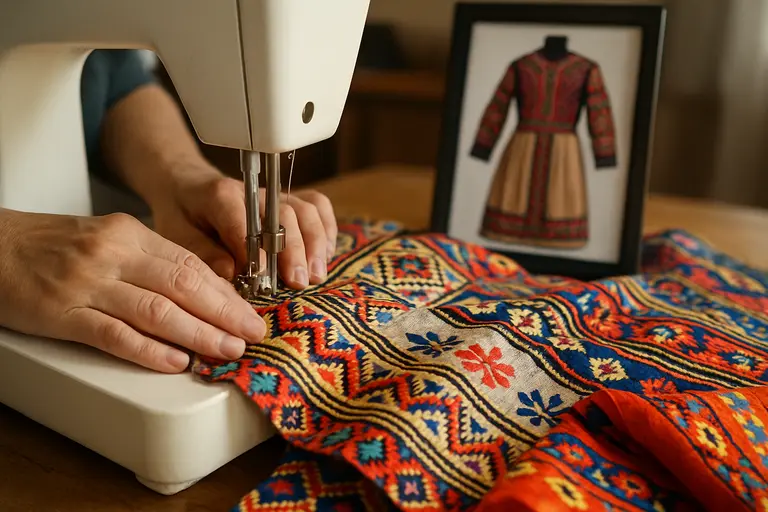
The safest creative path is to study composition, not copy imagery. Wick’s photographs are finished artworks with their own authorship, lighting decisions, prop relationships, and puzzle structure. A costume pattern inspired by them should use original symbols and color choices. Instead of recreating Yikes!, one might design a “tilted toy-room explorer” outfit with a new grid, different shapes, and an original arrangement. Instead of reproducing Clouds, one could sew layered pale fabric cuffs and a soft hat that suggests weather through texture.
This distinction is also good design practice. Direct replication can make a costume feel flat because the original work was composed for the camera, not for a moving body. Dress-up has different needs: durability, breathability, repairability, and room for improvisation. A child may decide that a moon prop is a shield, a puzzle token, or a bakery sign within the same afternoon. A good pattern leaves that interpretive space open.
Scale, Texture, And The Fairytale Costume Eye
Fairytale costume design often depends on scale shifts: tiny keys, oversized buttons, long sleeves, small crowns, huge bows. Wick’s fantasy worlds make those shifts feel analytical because every object asks the viewer to judge size and position. For I SPY Dress-Up, scale can become the main design tool. A normal vest can carry one oversized pocket watch made of felt. A simple dress can gain storybook tension through a single large chess-square hem. A wizard hat can hold a miniature ladder, stitched from ribbon, as if a tiny figure just climbed it.
Texture matters just as much. Glossy plastic, matte felt, cotton checks, and metallic paper all reflect light differently. Wick’s photographic practice depends on how objects read under a camera, while costumes must read in a room, a classroom, a party, or a play corner. Test the costume under normal indoor lighting before adding more pieces. If the contrast is weak, adjust color before increasing complexity.
Walter Wick Fantasy Worlds In Dress-Up Practice
The exhibition’s value for makers is its reminder that fantasy can be built from ordinary objects arranged with care. I SPY Dress-Up does not require expensive materials or exact replicas. It asks for a disciplined relationship between pattern, prop, and viewpoint. Start with one base garment, one visual rule, and one surprise. A cape with a checkerboard lining and three removable felt moons may communicate more clearly than a full costume crowded with unrelated symbols.
For adults designing play costumes, the benefit is practical as well as artistic. The maker can teach observation, spatial reasoning, and narrative play while preserving respect for Wick’s original works. The child wearing the costume is not pretending to be a photograph. They are learning how staged worlds are built: by choosing objects, placing them with intention, and allowing viewers to search. That is the lasting lesson of I SPY Dress-Up drawn from Walter Wick’s fantasy worlds.