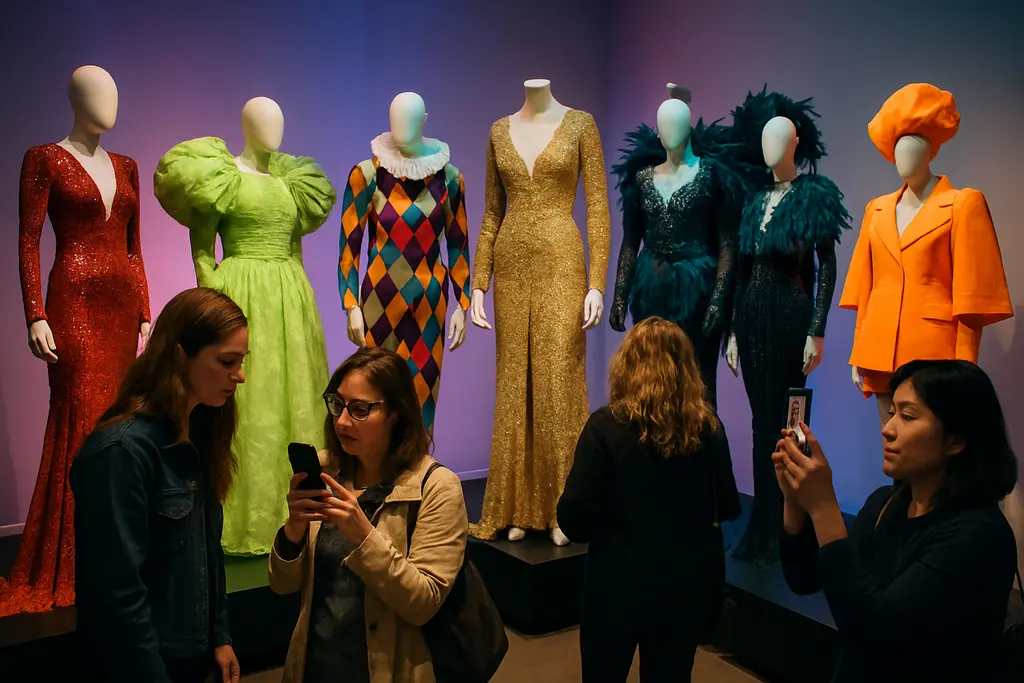
Costume Design Influences framed how Michael Jackson: The Fashion Legacy could be read after its Seattle presentation ended. The Museum of Pop Culture in Seattle opened the limited exhibition on August 22, 2026, and it ran through September 7, 2026, according to the museum’s event listing for Michael Jackson: The Fashion Legacy. As of September 21, 2026, the show belongs to recent exhibition history rather than an active museum calendar. That timing matters because the strongest reading now is retrospective: the display gathered a small group of garments and accessories to show how costume, sound, movement, and public identity were repeatedly fused in Jackson’s visual presentation.
The exhibition was produced through a partnership between MOPOP and Julien’s Auctions. Julien’s described the Seattle installation as drawing from select items in what it called the largest assembled collection of Jackson stage costumes, accessories, and music video-worn pieces, with the project linked to a broader international campaign and a December 5–10, 2026 auction program in Abu Dhabi under the same title Julien’s Auctions reported. The Seattle stop was not a large wardrobe survey in the usual museum sense. It presented about a dozen artifacts, which made the curatorial logic more concentrated: each object had to carry a heavy interpretive load.
The Exhibition After Its Seattle Run
A Short Display With A Narrow Artifact Group
The short duration of the show shaped how its design argument worked. A three-week run, with objects included in general MOPOP admission during the exhibition period, positioned the presentation as a focused cultural event rather than a long-term costume archive. That format can be productive for fashion analysis because it reduces visual noise. Instead of asking viewers to process decades of wardrobe variation, the show selected pieces tied to widely recognized performance moments: the Motown 25 shoes associated with the moonwalk on March 25, 1983; the Smooth Criminal suit; a Thriller video jacket; a Bad Tour jacket; and a glove from a VIBE magazine photoshoot that was reportedly among Jackson’s later public glove-worn appearances.
Because the exhibition has closed, the useful question is not whether the public can still see these objects in Seattle. The question is what the grouping revealed. The artifacts acted less like isolated celebrity relics and more like evidence of a performance system. Jackson’s fedora, loafers, shoulder emphasis, rigid jackets, military details, single glove, and sharply controlled silhouette were not decorative afterthoughts. In the exhibition’s framing, they helped stabilize a visual identity that could remain legible under stage lights, in music videos, in still photography, and in audience memory.
Costume Design Influences And Performance Identity
Silhouette As A Form Of Recognition
The clearest Costume Design Influences in the MOPOP presentation involved silhouette. Jackson’s clothing often worked through contrast: narrow trousers against strong shoulders, polished shoes against sudden footwork, glittering surfaces against severe garment structure. Those contrasts helped the eye track movement. A bright glove could isolate a hand gesture. A fedora could sharpen the line of a head tilt. Loafers could make foot articulation visible. A jacket with strong shoulders could hold a clean outline even when the body moved quickly.
This is where fashion analysis and performance analysis meet. A stage costume must survive motion, lighting, distance, sweat, and repetition. A garment may look powerful in a display case, but its original design problem was kinetic. The object had to read instantly to an audience while allowing highly controlled movement. In that sense, Jackson’s most famous looks are not just examples of pop styling. They are case studies in how costume can become a choreographic tool.
Costume Design Influences In Paired Artifacts
One of the exhibition’s most pointed curatorial choices was the pairing of the Thriller jacket with the Motown 25 loafers. Those objects come from different visual moments. The jacket points toward narrative music-video costuming, theatrical color blocking, and horror-pop imagery. The loafers point toward live television performance and the debut of the moonwalk for a mass audience. Shown together, they compressed two modes of Jackson’s public image: character-driven spectacle and stripped-down dance precision.
For DIY dress-up thinking, that pairing is more useful than a literal replica checklist. It suggests that a memorable costume can be built around a clear relationship between one graphic garment and one movement-centered accessory. A red jacket alone does not explain the image. A pair of loafers alone does not explain it either. The meaning comes from how the garment frames the body and how the footwear supports a recognizable performance vocabulary.
Key Garments As Design Evidence
The Smooth Criminal Suit And Functional Illusion
The Smooth Criminal suit remains one of the most instantly readable ensembles associated with Jackson. The research notes connect its construction to the gravity-defying angle in the video, where costume form had to support an illusion of physical impossibility without losing the crispness of the image. That point is useful because it resists a common weakness in celebrity fashion writing: treating clothing as surface alone. Here, the suit’s authority depends on line, fit, and performance need. The garment had to look composed while the body performed something that appeared unstable.
That tension between control and risk is central to the outfit’s appeal. The suit evokes formal menswear, but the performance context changes the reading. It becomes less about office or ceremony and more about theatrical precision. Its visual discipline gives the movement a sharper edge. In a museum setting, the garment can be read as evidence of how pop costuming borrows from formal dress while changing its purpose.
The Bad Tour Jacket And Object Biography
The Bad Tour jacket included in the exhibition carried a different kind of weight. The research notes state that it was designed by Tompkins and Bush and donated by Jackson to the Tony Martell Foundation. That detail reframes the garment as more than a stage object. It still belongs to the language of regalia, embellishment, and strong stage identity, but its later life as a donated object adds a second layer of meaning.
Museum costume displays often depend on object biography: where a piece was worn, who made it, how it circulated, and why it survived. In this case, the jacket’s performance value and philanthropic association sit together. A cautious reading should not inflate that detail into a broader claim about intent without stronger documentation. Still, it does show why provenance can change how viewers understand a garment. The same jacket can be read as costume, collectible, archive piece, and charity-linked artifact.
Lessons For DIY Dress-Up Interpretation

Reference Without Flattening The Source
Costume Design Influences work best for makers when they are treated as design principles, not as permission to flatten a specific artist into a costume formula. For a fairytale-fashion or dress-up project, the strongest lesson from the MOPOP grouping is clarity. Choose one dominant line, one functional accessory, and one controlled material effect. A military-inspired shoulder line, a single sparkling hand detail, or a polished shoe shape can teach proportion without copying an entire celebrity likeness.
This distinction protects artistic integrity. Jackson’s image was built across specific performances, collaborators, garments, and media contexts. A respectful maker can study the design grammar: contrast, shine, structure, hand emphasis, and dance visibility. That approach is more thoughtful than reproducing a famous look without context. It also gives creators more room to invent. A fantasy costume, for example, might borrow the idea of a luminous glove as a storytelling marker while changing the color, textile, character role, and silhouette entirely.
For readers comparing exhibition analysis with broader style reporting, Next Clues provides further insights and related cultural coverage across the same network. The same cautious approach appears in our discussion of Art Fashion Fusion 2026, where accessories and cultural references are treated as evidence rather than easy trend slogans.
- Study function first: ask what the garment helped the performer do.
- Reduce the reference: use one design lesson rather than a head-to-toe imitation.
- Change the story: adapt structure, shine, or proportion for an original character concept.
- Respect context: credit the source of inspiration when discussing the work.
Costume Design Influences After MOPOP
The closed Seattle exhibition now reads as a compact argument about pop costume history. Its strongest claim was not simply that Jackson wore memorable clothing. It showed that garments and accessories could become inseparable from performance identity when repeated across video, tour, magazine imagery, and public memory. The Thriller jacket, Motown 25 shoes, Smooth Criminal suit, Bad Tour jacket, and glove each carried a different design function, but together they mapped a consistent visual strategy.
For fashion observers, the value of the show lies in that strategy. The exhibition treated costume as evidence of collaboration, movement, and image-making. For dress-up enthusiasts, it offered a useful reminder: the most persuasive costumes are not always the most crowded. They often depend on one exact silhouette, one clear gesture, and one accessory that tells the audience where to look. That lesson remains useful after the museum cases have been cleared, especially for creators who want inspiration without reducing an artist’s work to surface imitation.