

Fade Literary Costumes ask for more than a misty cape or a quick “invisible person” joke. Robert Cormier’s Fade, published in 1988, centers on Paul Moreaux, a boy of French Canadian descent who inherits the ability to become invisible. The power passes through family lines, and the novel’s central tension grows from what each generation does with that inheritance. A costume inspired by this book should read ancestry, secrecy, and cultural loss as design problems, not as decoration.
The strongest starting point is the novel’s structure: Paul’s 1930s world, the later 1960s section involving his nephew Ozzie, and the 1988 frame in which Susan questions the truth of Paul’s manuscript. Scholarship on Cormier’s novel identifies the fader lineage across generations and connects invisibility to the decreasing visibility of French Canadian “Little Canadien” communities in New England Cormier scholarship. For DIY dress-up, that makes the costume less about spectacle and more about partial presence: garments that look ordinary at first, then reveal their symbolic structure through layering, translucence, and period shifts.
Fade Literary Costumes As Ancestral Design
Fade Literary Costumes And Generational Layers
A useful design method is to treat each generation as a visible layer. Paul’s portion can lean toward modest, workwear-inspired clothing that suggests immigrant labor life in 1930s New England without claiming to reproduce a single documented uniform. Ozzie’s 1960s position can be shown through sharper contrasts: a more casual jacket, a changed collar shape, or a stronger break between inherited family expectations and personal action. Susan’s 1988 role can be quieter: a sweater, skirt, notebook prop, or archival-feeling layer that signals inquiry rather than possession of the family gift.
This approach keeps the design cautious. It does not pretend that one garment can stand for all French Canadian communities in New England. Instead, it marks how identity shifts under pressure. A responsible Fade Literary Costumes concept can use three visible time bands: an underlayer for family origin, a middle layer for moral conflict, and an outer layer for later questioning. The wearer becomes a moving archive, but the archive remains incomplete, which suits the novel’s uncertainty.
Why Ordinary Clothing Matters
Invisibility in Fade is disturbing because it enters ordinary life. For costume work, plain garments can be more effective than fantasy armor. A faded shirt, a dark cardigan, a work jacket, or a simple dress can carry the idea that power is hidden inside familiar fabric. The costume should not announce itself too quickly. It can invite a second look through transparent cuffs, disappearing hems, or fabric panels that blur the body’s outline.
The children’s and young adult books category remains commercially significant: one market report placed the global children’s and young adult books market at US $12.16 billion in 2025 and projected US $12.44 billion in 2026 YA books market data. That does not prove a specific costume trend around Fade. It does, however, show that young reader texts continue to sit within a sizable cultural market where literary identity, school events, cosplay, and handmade interpretation can overlap.
Reading Invisibility Through Dress
Sheer Panels, Detachable Pieces, And Shadow Edges
The most direct visual cue is partial transparency. Sheer organza, gauze, mesh, or thin cotton can suggest disappearance without making the body vanish. A detachable sleeve, a half-apron, or an overlay that can be removed during performance gives the wearer a way to act out the inherited power. For child-friendly dress-up, the safest version is symbolic rather than technical: no long trailing fabric near stairs, no face-covering materials that restrict sight, and no brittle plastics that crack during play.
Color can carry the same idea. Gray, washed blue, cream, brown, and softened black suggest fading without needing theatrical effects. One sleeve might be darker than the other. A vest could be patched with paler fabric near the shoulder, as if the garment is losing density. These cues support Fade Literary Costumes because they connect the supernatural gift to the family’s social and cultural disappearance. The fade is not only a magic trick; it is a way to think about how people and communities become overlooked.
Three Eras In One Silhouette
A balanced design can place the 1930s, 1960s, and 1988 sections into one outfit without turning the wearer into a costume rack. Start with a simple base garment that reads earlier: a plain shirt, a longer skirt, trousers, or a vest. Add a mid-century interruption through a shorter jacket, a brighter lining, or a slightly bolder pattern. Finish with an archival 1988 layer, such as a neutral cardigan, a satchel, or a manuscript prop made from blank paper tied with string.
The trick is proportion. If every era fights for attention, the ancestral theme becomes noise. Keep one dominant period and let the others appear as evidence. A small 1960s collar over a 1930s-style base can say more than a full decade-by-decade reenactment. For related thinking on spectral staging, storage, and fairytale costume texture, the site’s piece on surreal fairytale staging offers a useful companion angle.
DIY Construction Without Flattening Culture
Surface, Context, And Emotional Core
A practical three-part test helps keep the costume respectful. First, identify the surface: fabric weight, color, collar shape, and visible aging. Second, name the context: French Canadian descent, New England immigrant life, and the novel’s generational structure. Third, define the emotional core: secrecy, inheritance, moral risk, and loss of cultural visibility. If a design only uses surface cues, it may feel like vague nostalgia. If it holds all three levels, it becomes a stronger literary reading.
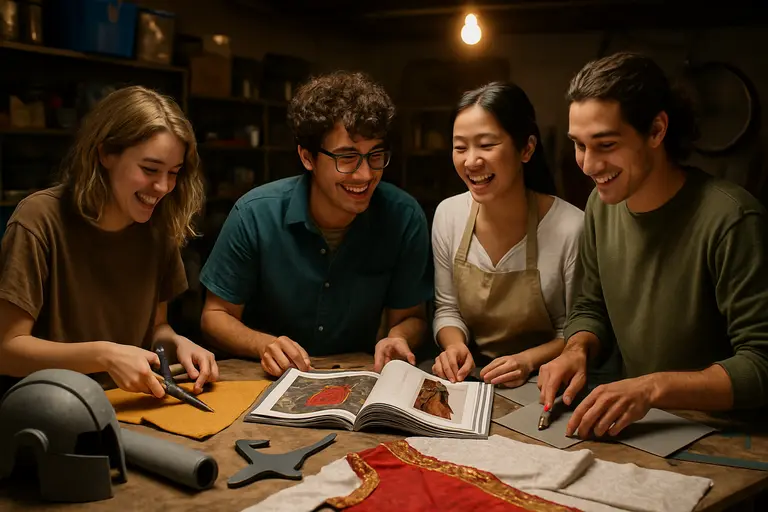
This does not require expensive materials. A thrifted shirt can be tea-dyed for a softened look. A cardigan can be patched with translucent fabric at the elbows. A vest can be lined with handwritten family names, fictional dates, or abstract marks rather than copied passages from the book. For personal use, those marks can help a child or adult performer remember the theme while avoiding a literal reproduction of cover art or another artist’s visual solution.
Materials That Suggest Memory
Good materials for this concept are humble: cotton, wool blends, muslin, cheesecloth, old buttons, dull ribbon, and paper. Each can be handled in a way that suggests age. Frayed edges can be finished with simple stitching so the costume remains wearable. Transparent overlays can be attached with snaps or ties, making the “fade” layer removable. If the outfit is for play, removable parts also make cleaning and storage easier.
A small prop can sharpen the interpretation. A folded manuscript, a family envelope, or a plain notebook links the outfit to Susan’s questioning frame in 1988. Keep the prop understated. The novel’s power lies in uncertainty, so a costume that leaves some things unresolved feels truer than one that explains every symbol. For broader creative prompts in the same network, Next Clues provides additional resources for exploring clue-based storytelling and thematic play.
Fade Literary Costumes For Respectful Play
Fade Literary Costumes work best when they resist easy spectacle. The novel’s ancestral theme is not simply “a family has a power.” It is a pattern of inheritance that grows more morally troubling as it moves through generations. Dress-up can show that pattern through layered eras, ordinary fabrics, softened colors, and controlled moments of transparency.
For classroom use, book events, or home play, the costume should make space for discussion. Ask what the outer layer hides. Ask which generation the wearer is showing most strongly. Ask whether invisibility feels like freedom, danger, erasure, or all three. Those questions keep the design connected to Cormier’s text rather than turning it into a generic ghost outfit.
A final caution is useful for makers and sellers. Literary inspiration is strongest when it interprets themes, not when it copies protected cover imagery, branded editions, or another designer’s distinctive costume work. That is not legal advice; it is an artistic practice that respects original works and encourages independent design choices. With that standard, a handmade Fade costume can become a thoughtful act of reading: part family history, part moral study, and part fairytale-like disappearance held inside everyday clothing.