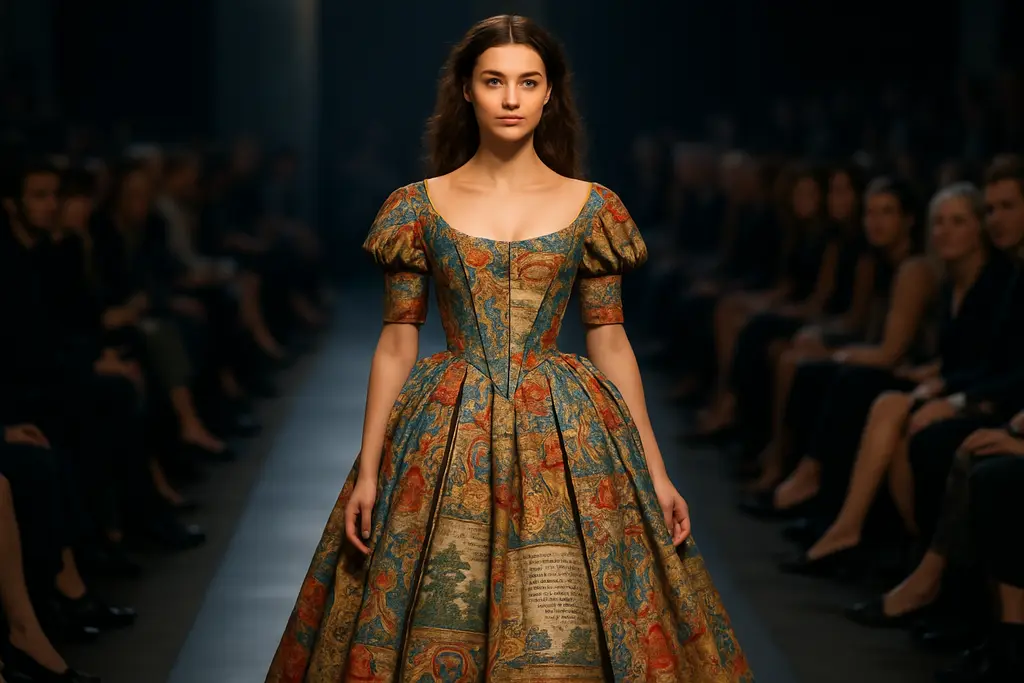

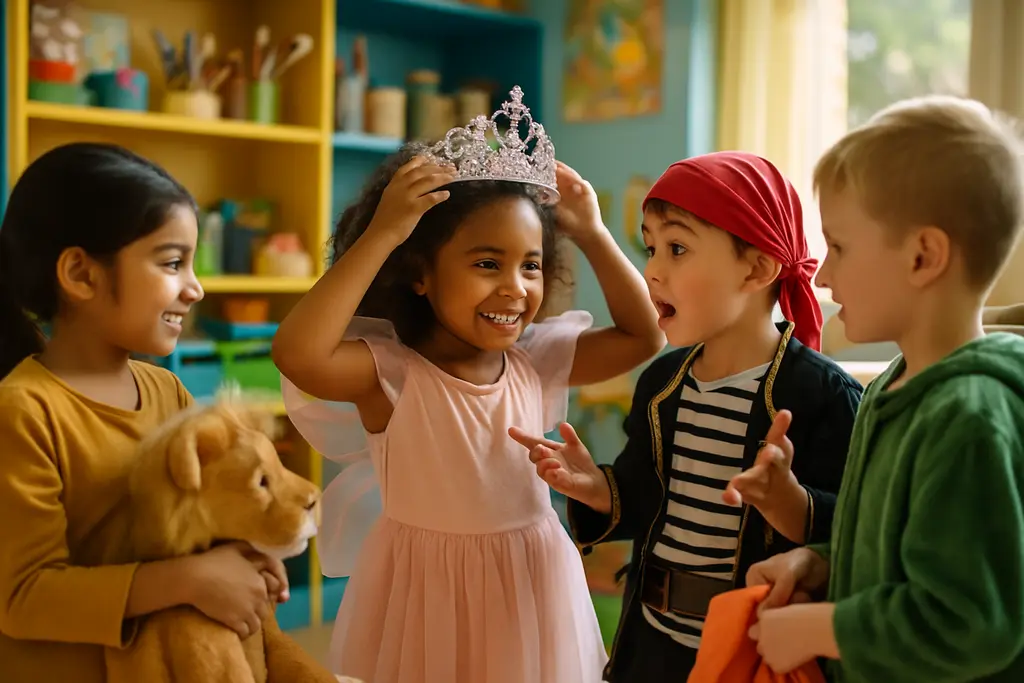
Dress-Up Play Benefits offer a useful, cautious frame for reading the artistic themes promised by áyA Con for young creators. As of October 8, 2026, the supplied research describes áyA Con as forthcoming, but it does not provide a confirmed date, venue, guest list, or program schedule. That matters: any developmental claim about the event itself would be premature. What can be assessed, with care, is how costume prompts, role play, handmade accessories, and character-building exercises may relate to established findings on pretend play in early childhood and youth creative practice.
Dress-Up Play Benefits And áyA Con’s Art Frame
A young-creator convention built around dress-up is not only a clothing event. It can become a studio-like setting where participants test roles, materials, symbols, and movement. The research base does not prove that one convention will improve a child’s planning skills or social confidence. It does suggest that pretend play is associated with several developmental domains that matter to art-making: flexible thinking, self-control, storytelling, social negotiation, and emotional expression.
Dress-Up Play Benefits And Executive Function
The strongest supplied evidence comes from pretend play research rather than from event studies. A March 2026 meta-analysis of 26 studies, covering 2,915 children aged 12 to 72 months, found a small but significant correlation between pretend play and executive function, with r = 0.17 and a 95% confidence interval of .13 to .20 pretend play meta-analysis. A small correlation should not be inflated into a promise. Still, for a costume-centered creator setting, it supports a reasonable design principle: structured make-believe tasks may give children practice in shifting rules, holding a role in mind, and adjusting behavior to a shared scene.
For áyA Con, that could mean asking young participants to design a woodland messenger, a moonlit inventor, or a sea-court apprentice without requiring any one correct answer. The benefit is not the costume alone. It is the mental work around the costume: selecting materials, deciding what the character wants, negotiating how that character speaks, and responding when another participant changes the scene.
From Costume Prompt To Story Rule
Artistic dress-up works best when it avoids becoming a pure imitation contest. A prompt such as “make a cape for a weather keeper” leaves space for color theory, texture, silhouette, and movement. A prompt such as “copy this recognizable screen character” narrows the exercise and raises rights and likeness concerns for creators who later want to sell photos, prints, patterns, or accessories. Respect for original works should sit beside creative freedom. Young makers can study broad influences—folklore, stage costuming, historical garment shapes, natural forms—without presenting replicas as original designs.
This distinction is especially useful for fairytale fashion. A crown can signal authority without copying a protected character. A wing shape can suggest flight without duplicating an existing franchise design. A stitched pouch can imply a quest, a trade, or a secret message while remaining the maker’s own visual idea.
Costume Design As A Young Creator Practice
Costume play asks for decisions that overlap with studio art. A creator chooses scale, balance, texture, color contrast, and how a garment behaves on a moving body. Those choices can be playful, but they are not trivial. A cardboard collar that tips forward teaches weight distribution. A fabric tail that snags on chairs teaches movement testing. A mask that muffles speech teaches the link between design and communication.
Material Limits Can Support Better Ideas
For áyA Con, limited materials may be more instructive than a large supply table. Paper, ribbon, felt scraps, fabric remnants, and safe closures can push participants toward problem-solving. If every child receives identical materials, the artistic interest shifts from purchase power to invention. One maker may fold paper into armor-like scales. Another may knot soft strips into a forest sash. A third may use negative space, leaving gaps that make the costume lighter and easier to move in.
This is where Dress-Up Play Benefits connect with design literacy. Young creators practice planning, but they also learn revision. A first idea may fail physically. A second version may work better. That process is not a failure of imagination; it is how costume design teaches the body, the material, and the story to cooperate.
Storytelling Without Overclaiming Outcomes
The supplied research notes include findings that pretend play can support language, role differentiation, creative thinking, social competence, and emotional regulation. Those are broad associations across studies, not guarantees for every child or every session. For an event designer, the safer takeaway is practical: give participants time to explain who they are portraying, what their object means, and how their role fits with another person’s role.
A child who says, “I am the bridge guard, and you need a silver leaf to pass,” is doing more than posing. The child is setting a rule, assigning a symbolic value, and inviting negotiation. That is a social and artistic act. It resembles the work of theater costume rooms and illustration studios, where a visual element must make sense inside a narrative system.
Inclusive Role Play Without Flattening Identity
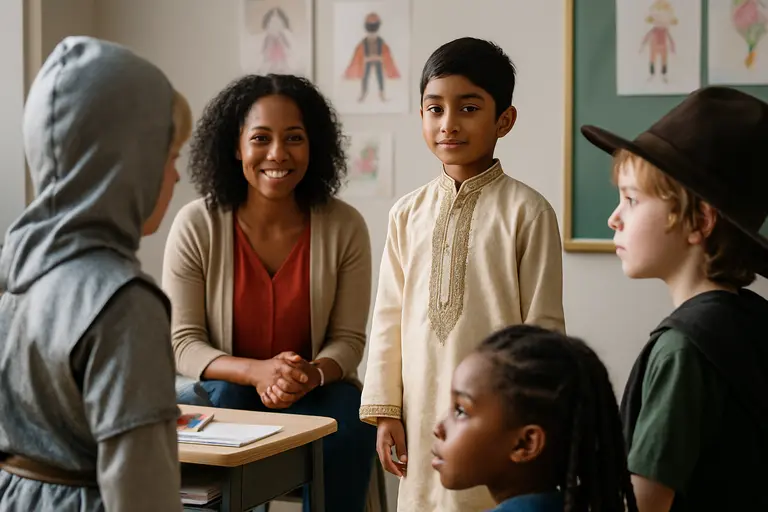
Dress-up play varies by gender, age, and cultural context, so a creator event should avoid assuming that every participant wants the same kind of fantasy. One longitudinal study reported that girls averaged dress-up play about once a week while boys averaged about once or twice a month; it also reported that 56% of girls and 31% of boys played dress-up weekly or more, with differing age patterns among African-American and Latino children in the sample preschool dress-up study. These figures should be read as findings from a specific study, not as fixed rules about children.
Choice Reduces Stereotype Pressure
For áyA Con, the evidence supports offering many entry points. Some participants may prefer heroic armor, some may prefer animal features, some may prefer soft ceremonial garments, and some may prefer props rather than clothing. The point is not to force every child into a public performance. Quiet design tables, small-group storytelling, and opt-in showcases can all respect different comfort levels.
Inclusive costume design also means avoiding a narrow set of gendered bins. A “royal workshop” can include scholars, gardeners, messengers, healers, mapmakers, cooks, guards, musicians, and cloud engineers. That range gives young creators more ways to participate without being steered into a single idea of beauty, bravery, or magic.
- Use open prompts that describe a function, not a fixed character.
- Separate inspiration boards from direct copying of identifiable works.
- Offer wearable and non-wearable options, including props and small objects.
- Allow solo making, paired storytelling, and group scenes.
- Encourage participants to explain materials and choices, not only display finished looks.
For readers exploring youth-culture and creative-event topics, Next Clues serves as a connected reference within the same network, enhancing understanding through its related discussions on these subjects. Within this site’s own archive, a related discussion of character events offers another cautious way to think about costume, social growth, and role-based play.
áyA Con Dress-Up Play Benefits
The most responsible reading of áyA Con is neither hype nor dismissal. If the event uses costume play as a structured art practice, it may give young creators a setting to test planning, symbolic thinking, collaboration, and self-expression. If it relies only on spectacle, shopping, or imitation, the learning value may be thinner. The difference lies in how the activities are framed.
What A Strong áyA Con Session Could Emphasize
A strong session would begin with a theme broad enough to invite originality: threshold guardians, dream archivists, lantern couriers, river tailors, or other open archetypes. Facilitators could ask participants to sketch one object, build one wearable element, and explain one rule of the world their character inhabits. This keeps the focus on authorship rather than costume expense. It also respects artistic integrity by steering young makers toward their own decisions.
Dress-Up Play Benefits are best understood here as a research-informed possibility, not an event guarantee. The evidence supports paying attention to pretend play, role negotiation, and costume-based storytelling. It does not support claims that a single convention can produce measurable developmental change without direct study. Still, áyA Con’s artistic promise is clear enough to analyze: costume can become a low-pressure bridge between fantasy, craft, movement, and narrative authorship when young creators are given time, choice, and ethical design boundaries.