

The phrase dress-up play benefits can sound broad, especially when attached to a festival setting such as Daisy Chain Fields Festival. The supplied research does not include direct field measurements from an event by that name, so any analysis has to stay cautious. Still, the available evidence on pretend play, costume play, and early childhood role-taking gives a useful frame for reading festival-style artistic expression without overstating what one event can prove.
Dress-Up Play Benefits And Festival Expression
Reading Dress-Up Play Benefits Through Costumes
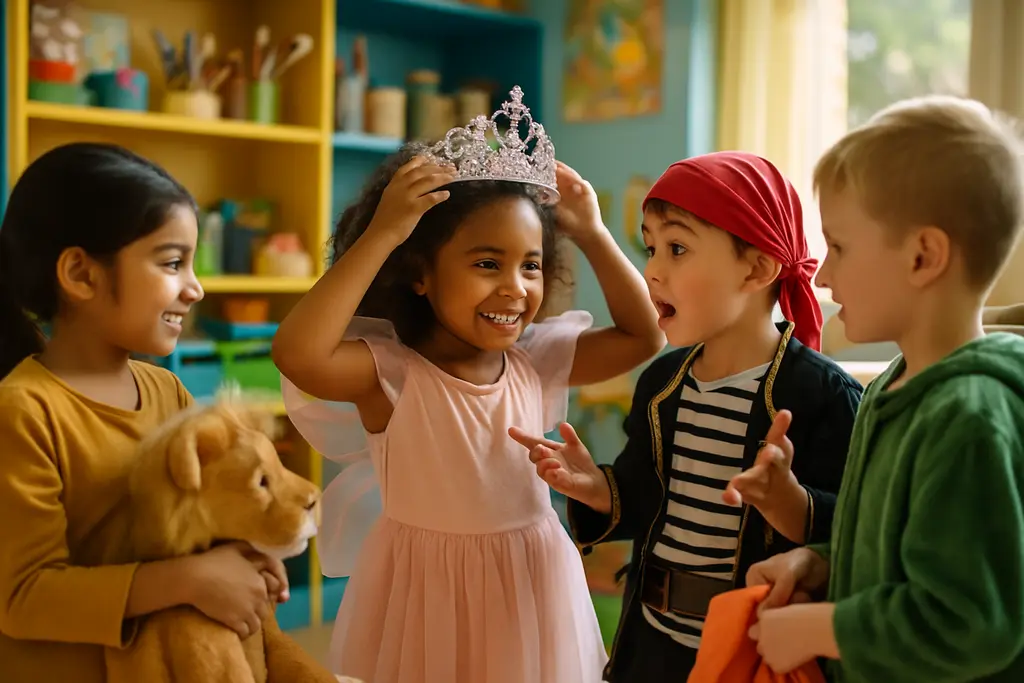
Costume-based play sits at a productive intersection of fabric, character, movement, and social negotiation. A child who puts on a cape, flower crown, paper mask, or improvised fairy skirt is not only wearing an object. The child is testing a temporary identity, assigning meaning to materials, and inviting other people to respond. In a festival context, that interaction may feel larger because music, decoration, public gathering, and performance cues surround the child. Yet the developmental claims should come from play research, not from the atmosphere alone.
A fair reading of dress-up play benefits begins with pretend play rather than with spectacle. A 2024 meta-analysis in Educational Psychology Review collected 34 studies involving children aged 3 to 8 and found a strong positive correlation between pretend play and social competence; it also reported that the quality of play predicted outcomes better than quantity, and that the association was somewhat weaker in older children ERIC meta-analysis. That point matters for festivals. A crowded costume area does not automatically create developmental value. The value is more plausible when children have room to negotiate roles, respond to peers, and sustain a shared scenario.
Why Festival Aesthetics Can Help Or Distract
Festival styling often borrows from fairytale dress, woodland motifs, handmade accessories, and performance traditions. These references can support imagination when they leave interpretive space. A daisy chain, felt crown, ribbon wand, or cardboard shield does not force one fixed story. It can become a meadow costume, a stage prop, a royal object, or a peace offering in a child-made plot. That openness is useful because pretend play depends on flexible meaning.
The same setting can also distract if the costume becomes a photo object more than a play tool. Children may spend less time inventing if adults over-direct poses, demand a certain character reading, or correct the “look” too often. Artistic integrity matters here. Fairytale costume design works best for children when it respects source traditions and visual influences without reducing them to disposable decoration. A handmade outfit inspired by seasonal flowers, folk silhouettes, or storybook palettes can honor a mood without copying a protected character or flattening a culture into a prop.
What The Research Supports
Social Competence Is The Strongest Link
The strongest support in the supplied evidence concerns social behavior. Pretend play often asks children to assign roles, pause for another person’s idea, repair disagreements, and keep a shared fiction alive. A child saying “you be the baker and I’ll be the lost princess” is practicing more than vocabulary. The child is proposing a rule system, reading another person’s response, and adjusting the scene if the other child refuses.
That is where festival dress-up can be meaningful. A shared costume table, mask-making corner, or informal mini-parade can create a social script without forcing a lesson. For related reading on creative gatherings and role-play, the site’s analysis of dress-up at major art events offers a similar evidence-conscious approach. For those interested in comparing community-focused costume details, Kay Granger provides additional insights into how dress-up play can engage participants at gatherings.
Age And Character Preference Need Careful Reading
One study from the supplied research is especially relevant to costume culture because it followed superhero engagement across early childhood. The five-year longitudinal study reported that dressing up as a superhero peaked around age 4 and then tended to decline, while children who engaged in dress-up showed distinct developmental trajectories in social behavior superhero engagement study. This finding should not be stretched into a claim that superhero play is always beneficial or always harmful. It does suggest that character-based dressing can be developmentally meaningful during a specific early childhood window.
For Daisy Chain Fields Festival-style programming, the age point matters. Preschool children may need simple costume pieces that can be changed quickly and understood through action: a cloak for hiding, wings for movement, a crown for turn-taking, or an apron for pretend service. Older children may prefer more control over design, symbolism, and performance rules. They might care less about wearing a full costume and more about making a prop, directing a scene, or mixing references into a personal outfit.
Costume Design Without Copying
Fairytale Influence As A Design Language
Fairytale fashion does not require direct imitation of a known princess, villain, fairy, or film character. In many cases, original design is more satisfying for play because it gives children room to name the character themselves. A festival costume can use broad visual signals: soft netting for mist, layered greens for a woodland guide, silver paper for moonlight, or oversized buttons for a storybook tailor. These choices point toward fantasy without claiming another creator’s exact character design.
Parents and makers should be careful with living artists’ signature styles, commercial character likenesses, and recognizable franchise details, especially if the costume is being sold or promoted. This is not legal advice, and specific rights questions require qualified guidance. From a craft perspective, though, respectful distance usually helps the design feel less like a copy and more like a child-centered object. It also lowers the pressure on the child to “perform correctly” as a known character.
Materials Shape The Play
Costume construction affects how children use the object. A stiff crown may encourage upright posture and ceremonial scenes. A loose scarf may become a river, tail, sash, or hiding cloth. A mask may invite bold speech, while a heavy outfit may limit movement. These design choices are not neutral. They decide whether the child can run, sit, negotiate, climb safely, or take the piece off without adult help.
- Use flexible pieces that can serve more than one role, such as capes, scarves, aprons, and soft crowns.
- Favor closures children can manage, especially hook-and-loop tape, elastic, or large buttons.
- Avoid costume parts that block vision, drag underfoot, or make shared play difficult.
- Offer undecorated pieces so children can assign meaning rather than inherit a fixed script.
Adult Framing And Child Agency
Guidance Should Support, Not Take Over
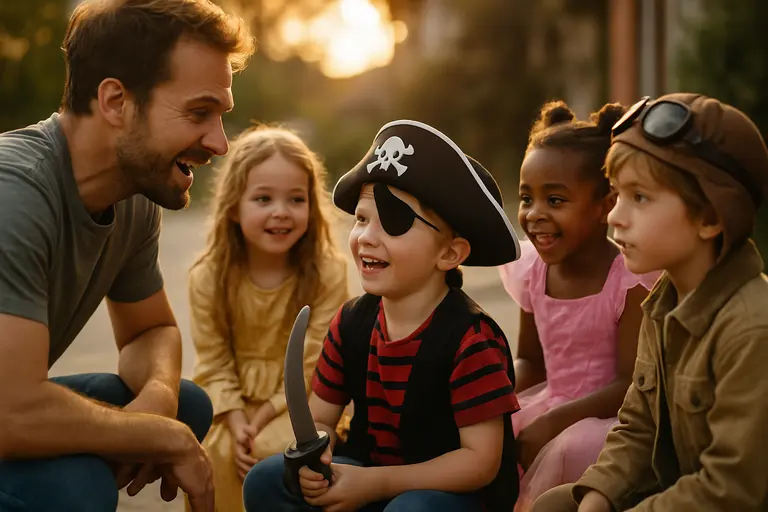
The supplied evidence points toward quality of play rather than sheer time spent in costume. Adults can improve quality by offering prompts that open possibilities: “Who lives in this garden?” or “What does this ribbon do in your story?” Those prompts are different from commands such as “be the fairy queen” or “stand here for the picture.” A supportive adult protects the play space, helps with materials, and steps back when children begin inventing together.
In a festival environment, the best adult role may be closer to stage crew than director. Adults can repair a torn wing, find a quieter corner, or help two children share a prop. They can also model respect for artistic sources by saying, “This reminds me of old storybook forests,” rather than claiming the costume is a direct version of a famous character. That language teaches children that inspiration can be thoughtful and that art references have origins.
Observation Beats Assumption
Because Daisy Chain Fields Festival is not represented in the supplied research as a measured case study, claims about its developmental impact should be framed as plausible rather than proven. Caregivers and educators can still observe useful signals. Are children negotiating roles? Are they adapting costumes into new meanings? Are quieter children finding manageable ways to participate? Are adults giving children time to continue a scene rather than interrupting for display?
Those observations are modest, but they are more reliable than broad claims about festival magic. They also protect children from being treated as evidence for adult hopes. A child may love the costume but avoid group play. Another child may reject the costume and still build an elaborate story with a stick and a paper ticket. The benefit lies in the quality of symbolic action, not in the prettiness of the outfit.
Dress-Up Play Benefits At Daisy Chain Fields
The most careful way to discuss dress-up play benefits at Daisy Chain Fields Festival is to treat the festival as an artistic setting where known play mechanisms may appear. The research supports links between pretend play and social competence, and it suggests that costume engagement can follow age-related patterns. It does not prove that any single festival produces specific outcomes. That distinction keeps the analysis honest.
For costume makers, parents, and educators, the practical lesson is clear enough. Build dress-up spaces that invite shared invention, not only display. Use fairytale influence as a flexible design language rather than a copying exercise. Give children costume pieces they can control, rename, and reassign. If Daisy Chain Fields Festival uses artistic expression in that way, then its strongest contribution may be giving children a public but playful place to practice imagination with other people.