
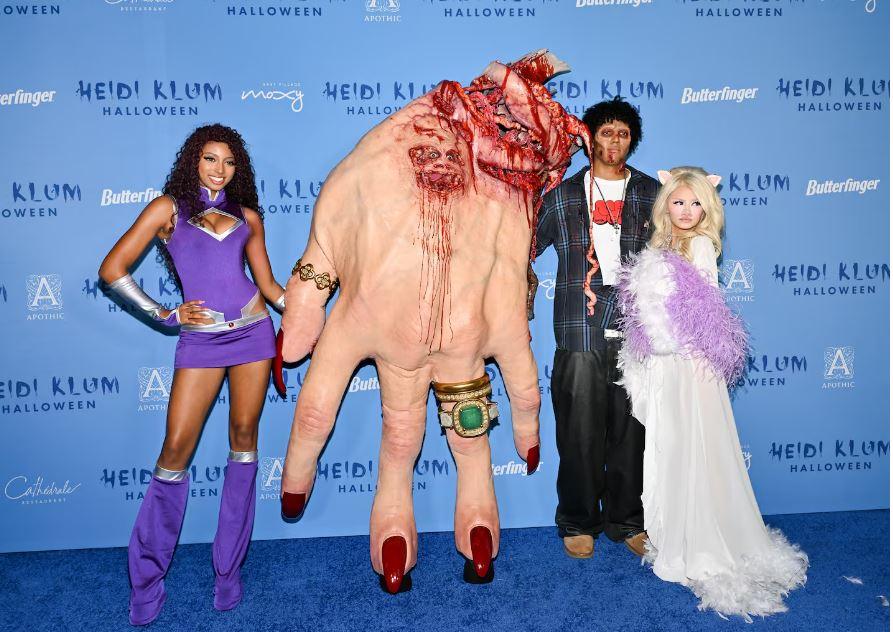
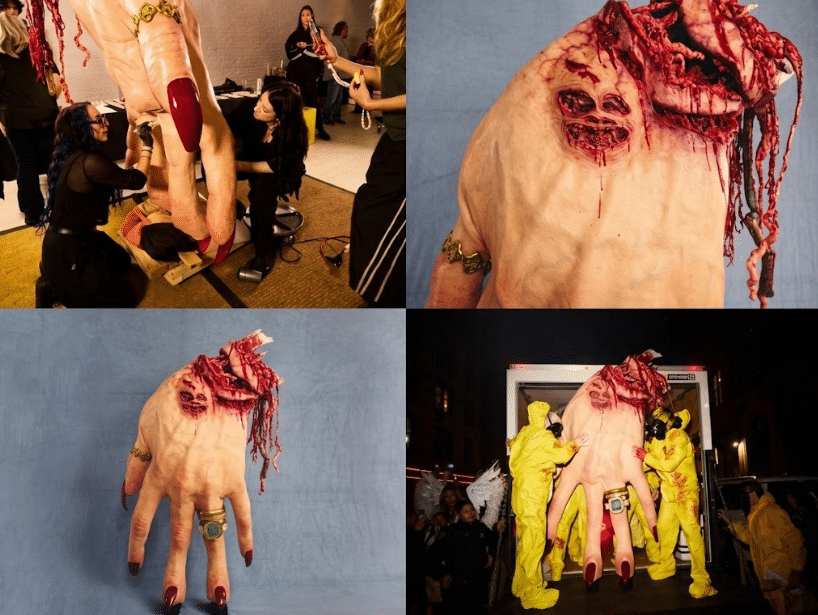
Heidi Klum celebrated the 25th anniversary of her legendary Halloween party on October 31, 2026, at Cathédrale in New York City. The supermodel bypassed traditional glamorous outfits to deliver a masterclass in extreme body horror. She arrived dressed as a massive, bloodied replica of her own severed left hand. The presentation erased her human silhouette entirely. The structure replaced her natural proportions with exposed tissue, long red-painted nails, and protruding anatomical ligaments. This project required a massive team of special effects artists and took months to engineer. The final garment treated human anatomy as a canvas for industrial-scale prosthetic construction. The event solidified her undisputed position as the reigning champion of celebrity costume events. The sheer scale of the appendage forced attendees to evaluate the outfit as a piece of kinetic sculpture rather than standard festive apparel.
The Origin Of The Grotesque Concept
The base concept for this presentation originated during the previous year’s Halloween event. Klum looked down at her own hand and determined she could fit her entire body inside a scaled-up version. This idea required abandoning standard dressmaking techniques. Translating a small human appendage into an eight-foot-tall wearable enclosure demands intense mathematical scaling. The designers had to map the exact locations of her eyes and mouth to guarantee she could see and breathe. They positioned her face directly in the center of the giant palm. Her eyes and mouth peeked out through a small, camouflaged opening. Her physical legs integrated into the lower finger structures. This design isolated the wearer inside a heavy silicone and foam cage. The sheer mass of the hand made movement incredibly difficult. Klum admitted that carrying the heavy structure proved to be the hardest part of the entire night.
Anatomical Architecture And Visual Gore
The top section of the costume replicated a violently severed wrist. Fake blood, exposed flesh, and torn ligaments dangled from the upper opening. The artisans painted the severed stump with high-gloss acrylics to mimic wet, fresh blood. The visual impact relied heavily on this hyper-realistic detailing. The lower section featured five enormous fingers terminating in long, blood-red fingernails. The glossy red polish on the nails provided a stark color contrast against the pale, wrinkled skin of the prosthetic hand. The skin texture itself featured enlarged pores, distinct knuckles, and raised blue veins. The viewer experiences a highly unsettling sensation when viewing familiar microscopic skin details enlarged to the size of a human torso. This manipulation of scale sits at the core of effective body horror. The costume forces the audience to confront the fragile, biological reality of the human body through an exaggerated, monstrous lens.
The Prosthetic Renaissance Engineering Process
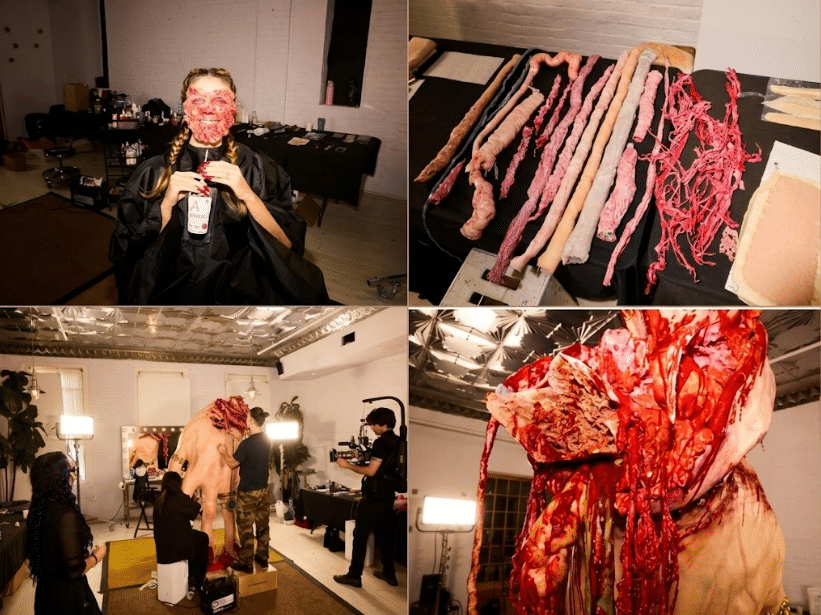
Executing a project of this scale requires infrastructure normally reserved for blockbuster cinema. Klum collaborated with Mike Marino and his team at Prosthetic Renaissance, a studio famous for its Emmy-winning work on HBO’s The Penguin. A team of 15 people spent months sculpting, casting, and painting the giant appendage. The artisans modeled the giant hand directly on Klum’s actual left hand, capturing every natural wrinkle and crease. The construction rejected mass manufacturing. Every single detail was crafted by hand, from the individual wrinkles to the painted veins. On the day of the event, the application process took five to six hours to complete. This extensive fitting required locking Klum into the heavy prosthetic shell and seamlessly blending her visible facial features into the artificial skin of the palm. The physical toll of wearing such a dense, restrictive outfit highlights the extreme dedication required to maintain her annual spectacle. Designing wearable art at this level requires the same technical precision seen in top-tier Hollywood special effects studios.
Replicating Personal Details And Jewelry
The designers integrated highly exact personal artifacts into the oversized anatomy. The giant hand featured massive, custom-built replicas of the rings Klum wears daily. This included exact copies of her engagement ring and her wedding band. Scaling up fine jewelry to fit an eight-foot hand requires industrial metalworking or heavy-duty 3D printing. The team went a step further by recreating a specific tattoo. A massive replica of her husband Tom Kaulitz’s name appeared tattooed on the ring finger. Tom Kaulitz could not attend the 2026 party due to touring commitments. Incorporating his name and their wedding jewelry allowed Klum to bring a piece of him into the physical structure of the costume. These micro-details provided a sharp contrast to the gory, oversized nature of the severed wrist. They added a layer of personal narrative and romance to an otherwise terrifying visual.
The Theatrical Hazmat Arrival
A costume this massive requires dedicated stage management. Klum did not simply walk out of a standard passenger vehicle. She made her entrance at the Manhattan venue arriving in a large truck covered entirely in red warning signs. A support team assisted her exit from the vehicle. These handlers wore blood-stained yellow hazmat suits. The hazmat theme created an immediate environmental context for the severed hand. It framed the costume as a hazardous biological specimen retrieved from a disaster site. The handlers helped support the heavy prosthetic as she walked the red carpet. This theatrical coordination guarantees the costume reads correctly for the assembled press and photographers. The environment functions as a literal extension of the outfit. The yellow suits provided a bright, primary color contrast to the pale skin and dark red blood of the central costume.
An Accidental Glimpse At The Batman Sequel
The preparation for this event triggered an unexpected Hollywood news cycle. Marino’s Prosthetic Renaissance studio serves as the primary makeup hub for Matt Reeves’ The Batman universe. Behind-the-scenes photographs documenting Klum’s fitting accidentally captured several background objects on the workshop shelves. Internet sleuths quickly identified containers labeled “Zsasz” and “Owl 3”. In DC Comics lore, Victor Zsasz is a notorious serial killer. The Court of Owls operates as a secretive, wealthy syndicate. The photos captured a damaged facial cast resembling actor Brian Tyree Henry. This sparked immediate theories about the character Two-Face appearing in the upcoming film. The documentation of a celebrity Halloween costume unintentionally fed massive speculation regarding the villains slated for The Batman Part II. This crossover proves how deeply high-level Halloween costuming relies on the exact same infrastructure used for major film production.
Contextualizing A Quarter-Century Of Costumes
Klum applies a consistent philosophy to her October projects. She takes a recognizable, ordinary concept and scales it up to absurd, terrifying proportions. This approach requires escalating the shock value every single year. The 2026 party marked her 25th year hosting the event. Her archive of outfits serves as a historical record of modern special effects makeup.
| Year | Character Presentation | Primary Structural Element |
| 2022 | Giant Earthworm | Full-body ridged foam tube |
| 2023 | Peacock | Human dancers forming functional feathers |
| 2024 | E.T. the Extra-Terrestrial | Animatronic neck and glowing fingertip |
| 2025 | Medusa | Snake-covered headpiece and reptilian tail |
| 2026 | Severed Left Hand | Giant prosthetic fingers and exposed tendons |
The 2026 severed hand pushes the boundary of body horror further than her previous iterations. Hiding her face and turning her legs into fingers completely erased her human silhouette. The project requires massive funding, intense physical endurance, and a willingness to look genuinely grotesque. It sets a demanding standard for avant-garde runway styling and high-end theatrical dress. Klum proves that the most effective visual statements happen when a designer completely ignores standard anatomical rules.
The Physical Endurance Of Extreme Costuming
Wearing an eight-foot silicone structure demands peak physical stamina. The wearer carries the entire weight of the foam and rubber on their shoulders and hips. Heat gets trapped inside the non-breathable synthetic materials. The restrictive eye-holes limit peripheral vision entirely. Klum’s ability to move through a crowded New York City nightclub inside this apparatus requires extreme spatial awareness. The 15-person crew built an internal harness system to distribute the weight evenly across her torso. Without a rigid internal skeleton, the heavy fingers would collapse under their own weight. The engineering behind the costume solves these exact gravitational problems.
Social Media Reaction And Public Reception
The public response to the outfit broke standard engagement metrics across digital platforms. Videos of the red carpet arrival gained immediate traction. Instagram users flooded the comment sections with praise for the technical execution. One user noted the look “always surpasses expectations,” praising the consistent quality of her annual reveals. Another commenter stated, “could’ve given us 100 guesses and we wouldn’t have gotten it”. This element of total surprise acts as the primary marketing engine for the annual party. Fans expect an unpredictable, highly engineered spectacle. The severed hand delivered exact anatomical horror wrapped in a high-fashion context. The viral nature of the event guarantees massive brand visibility for the sponsors and the special effects studio involved.
The Economics And Branding Of The Event
The annual Heidi Klum Halloween party operates as a major commercial enterprise. The 25th anniversary event required significant corporate partnerships to fund the venue, the catering, and the security detail. The costume itself represents a massive financial investment. Hiring an Emmy-winning studio for months of custom fabrication costs tens of thousands of dollars. Klum leverages this investment into absolute media dominance. The photographs from the red carpet dominate entertainment news cycles globally for several days. This guaranteed press coverage provides massive returns for the brands associated with the event. The severed hand costume functioned perfectly as a high-yield marketing asset. It generated endless headlines and proved that physical, practical effects still command total attention in a heavily digitized media environment.