
The Paris Couture exhibition at the Minneapolis Institute of Art gives handmade fashion trends a rare museum setting where construction, surface work, and silhouette can be read as evidence rather than mood. Running from October 4, 2026 through January 17, 2027, the exhibition brings more than 80 haute couture pieces from the Palais Galliera to Minneapolis, according to the Minneapolis Institute of Art. For DIY dress-up makers and fairytale costume enthusiasts, the show is useful not because it offers patterns to copy, but because it clarifies how couture builds fantasy through labor, proportion, and material discipline.
Handmade Fashion Trends And Couture Evidence
Handmade Fashion Trends In Century-Long Dialogue
The exhibition spans work from the late 19th century to the present, which lets viewers compare handmade techniques across radically different fashion periods. That long timeline matters. Corsetry, hand-embroidery, draping, appliqué, beadwork, and structural cutting do not appear as nostalgic ornaments here. They function as design systems that keep returning in revised forms.
A useful example is the reported pairing of a 1924 Chanel evening dress with a Spring-Summer 2026 Chanel evening dress and jacket. The Star Tribune review described how the exhibition places historical and contemporary couture in conversation, showing recurring silhouettes, materials, and hand techniques across roughly a century. This kind of display resists the easy claim that fashion simply moves forward. It suggests that certain handmade ideas pause, return, and change under new cultural and material pressures.
Why Museum Display Changes The Reading
On a runway, a garment is seen in motion, often for seconds. In a museum, the viewer can study the evidence of construction: where weight gathers, where the surface catches light, and where the body has been reshaped by support systems. Couture is not only decoration; it is controlled engineering. That point is especially helpful for fantasy costume makers who want drama without treating couture references as costume shorthand.
The ethical design lesson is restraint. A maker can study how a cape frames the shoulders, how beadwork directs the eye, or how a stiff textile holds a bell-like shape without recreating a specific protected design. For readers interested in careful drafting cues, our related piece on Paris couture patterns considers how historical construction ideas can support original work rather than imitation.
Materials, Labor, And The Shape Of Fantasy
Embellishment As Structure
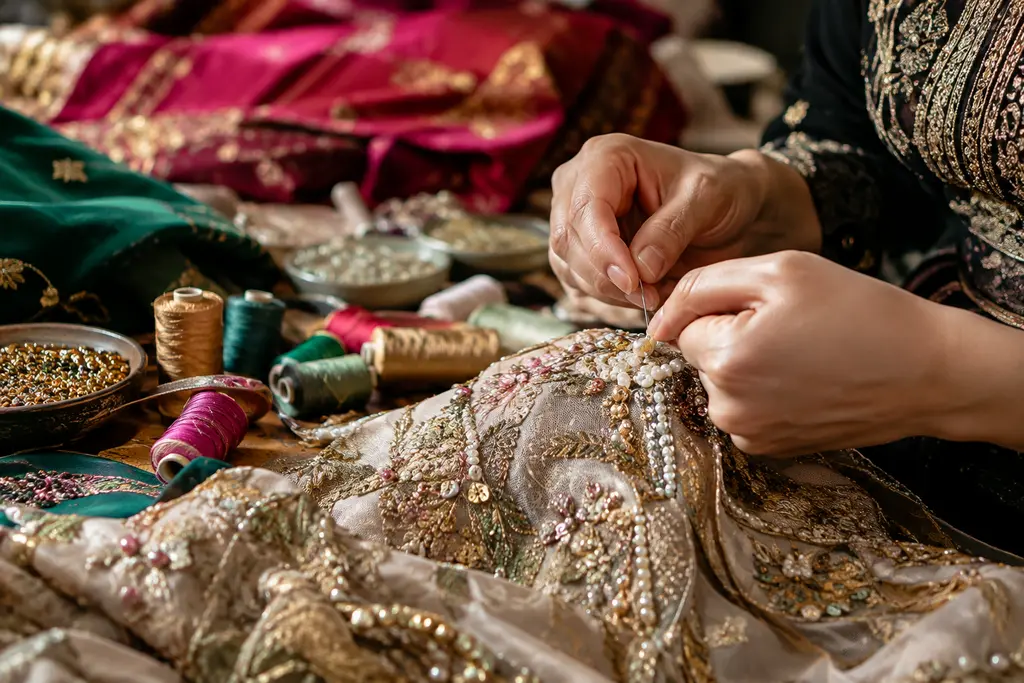
Several exhibition examples show how surface detail can become architecture. Elsa Schiaparelli’s shocking-pink 1938 evening cape, described in the exhibition materials, includes hand-embroidery by Maison Lesage using sequins and gold thread in a sunburst formation. Christian Dior’s 1952 “Palmyre” dress, worn by Wallis Simpson, is noted for heavy handmade embellishment with sequins, pearls, and crystals. These are not minor trims. Their placement changes the garment’s visual gravity.
For handmade fashion trends, that distinction is central. Beads, sequins, pearls, and crystals can add weight, stiffen fabric, and create focal points. In DIY dress-up terms, this supports a practical rule: use shine where it clarifies the silhouette. A scattered application may read as craft clutter, while a concentrated panel, border, or radiating motif can make a simple base garment feel intentional.
Unusual Textiles And Controlled Volume
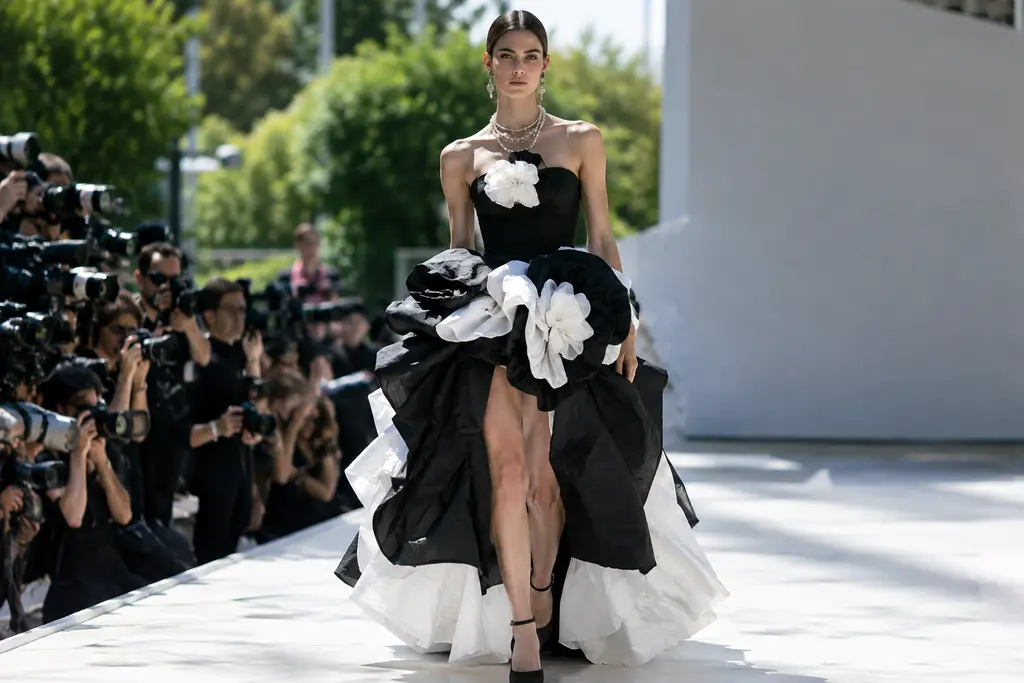
The exhibition also includes examples tied to material innovation. Cristóbal Balenciaga’s 1967 ensemble using gazar is especially relevant because the fabric supports dramatic shape through cutting and structure. Other works noted in coverage include ostrich feathers, synthetics in post-1958 to 1975 pieces, and modern looks using thousands of translucent fabric scales that appear to float.
For fairytale costume design, this is the practical bridge between couture and play. A maker does not need rare couture textiles to learn from these garments. Lightweight organza, layered net, shaped felt, fabric scales, and supported collars can suggest volume without pretending to be haute couture. For broader creative culture context in the same network, readers may find interesting insights on arts and fashion at robsonic.org, which offers related arts coverage.
- Use weight deliberately: heavier embellishment belongs where the garment can support it.
- Separate reference from reproduction: study proportion, not the exact artwork of a couture house.
- Test movement early: sculptural shapes can fail if walking, sitting, or arm movement is ignored.
- Let one technique dominate: beadwork, pleating, feathers, or fabric scales usually read better when not competing equally.
Cultural Narrative Without Costume Flattening
Revival, Decline, And Return
The exhibition’s account of couture includes a decline in the 1960s as ready-to-wear gained force, followed by revivals in the late 20th and early 21st centuries. Designers such as Christian Lacroix, John Galliano, Jean Paul Gaultier, and Alexander McQueen appear in those revival sections, according to the research notes supplied for this article. The key lesson is not that couture disappeared and came back unchanged. Rather, couture’s public meaning shifted as fashion production, media attention, and cultural expectations changed.
That shift matters for handmade fashion trends because handmade work now carries several meanings at once. It can signal luxury, preservation of skill, resistance to disposability, theatrical identity, or cultural storytelling. Those meanings should not be collapsed into a single “craft comeback” claim without evidence. The exhibition supports a narrower, safer reading: hand techniques remain influential because they solve visual and structural problems that industrial speed often avoids.
Representation And Material Identity
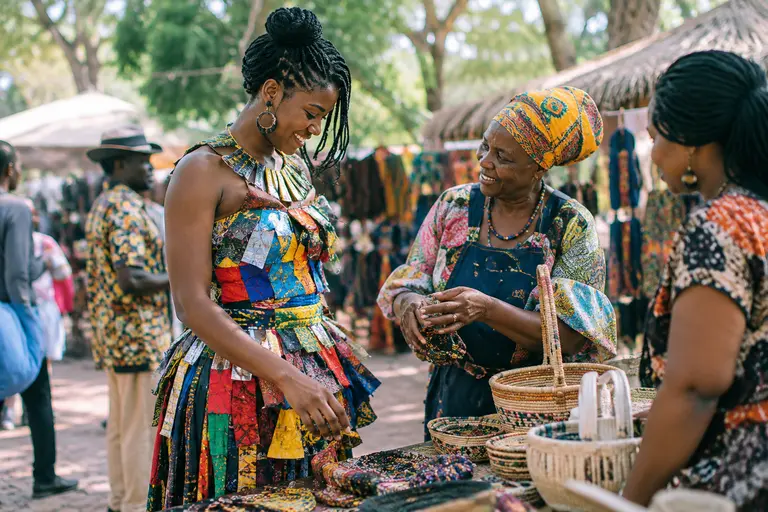
The inclusion of Imane Ayissi is especially significant in the exhibition’s cultural frame. The research notes identify Ayissi as the first Black designer from sub-Saharan Africa to present at Paris Haute Couture Week, and describe a 2020s ensemble that blends traditional couture techniques with African textiles. That placement broadens the story beyond Paris as a closed European inheritance, while still requiring careful language. Cultural materials and techniques should be credited, contextualized, and treated as design knowledge rather than surface exoticism.
For creators selling handmade costume pieces, the cautious takeaway is clear. Inspiration should not erase source communities, specific makers, or named designers. If a piece is influenced by museum study, describe the construction problem it solves: a shaped sleeve, a beaded neckline, a supported skirt. Avoid marketing language that implies affiliation with couture houses, living designers, or cultural traditions that the maker has not earned the right to represent.
Handmade Fashion Trends From Paris Couture
The strongest reading of Paris Couture at Mia is that couture fantasy is built through decisions that can be studied: fabric weight, body support, surface density, and historical reference. Handmade fashion trends visible in the exhibition are not quick trend signals in the social-media sense. They are slower craft patterns that survive because they keep producing convincing form.
For DIY dress-up and fairytale fashion, that is a generous lesson. A child’s cape, a theatrical crown, a formal costume bodice, or a hand-beaded collar can borrow the logic of couture without claiming couture status. The best response is not duplication, but translation: choose one structural idea, test it honestly, and let the handwork serve the story the garment is meant to tell.