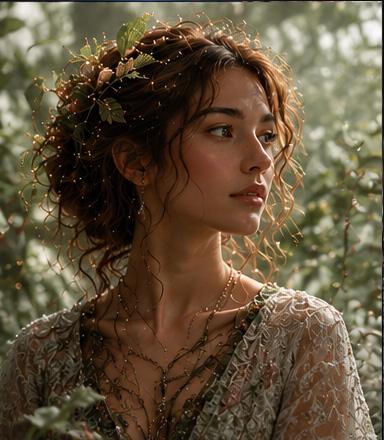
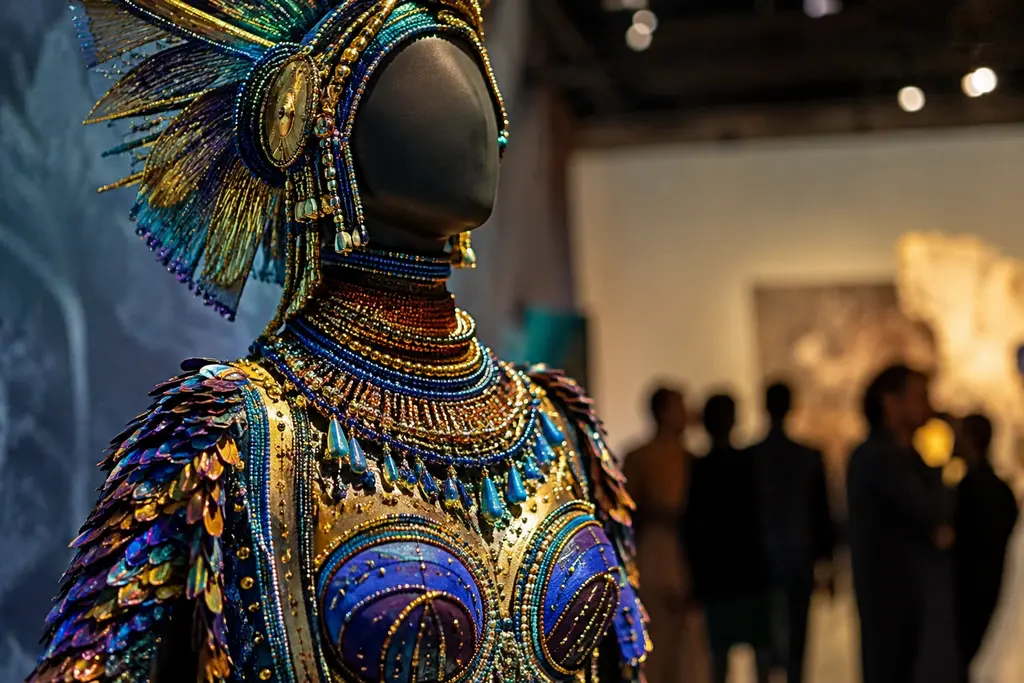
Afrofuturist Costumes offer a precise way to read Women of Afrofuturism at SFO Museum: not as decorative fantasy alone, but as a study in speculative dress, cultural memory, and inclusive visual storytelling. The exhibition opened on May 17, 2025, and runs through November 18, 2026, in the 1D Alley Gallery of Harvey Milk Terminal 1, Departures Level 2, Boarding Area B, according to the SFO Museum announcement. As of October 28, 2026, that places the show near the end of its run, which matters for how we read it: the installation has already had time to gather public attention while still remaining available to ticketed travelers behind security.
How Afrofuturist Costumes Work In The Gallery
The exhibition foregrounds Black women’s contributions to Afrofuturism through visual art, speculative culture, historical reference, and wearable forms. The research notes identify artists including Celia C. Peters, Nettrice Gaskins, Alisha B. Wormsley, Afatasi the Artist, and D. Denenge Duyst-Akpem. That range matters because costume thinking does not sit in one medium here. It appears through fabric, plastic, digital imagery, mythic reference, space-age surfaces, and apparel connected to filmic world-building.
Afrofuturist Costumes As Protective Dress
The strongest Afrofuturist Costumes in this context feel protective before they feel theatrical. Space helmets, metallic surfaces, reflective textures, and sculptural ensemble pieces suggest armor, travel, ritual, and arrival. A fairytale costume often grants a character a new social status: a cloak protects, a slipper identifies, a crown authorizes. In Women of Afrofuturism, similar visual tools point toward survival and self-definition rather than passive enchantment.
Afatasi the Artist’s wearable art is especially useful for costume analysis because the research notes describe garments that fit a variety of sizes, with many pieces designed as unisex. That design choice shifts fantasy costuming away from rigid princess/warrior binaries. It suggests that speculative dress can make room for bodies and gender expressions often narrowed by commercial costume categories. In a playroom or maker studio, that lesson is practical: capes, tunics, soft helmets, and modular accessories serve more children, more guests, and more kinds of imaginative play than tightly coded outfits.
Airport Display And Museum Context
SFO is not a neutral white-cube setting. It is a working travel site, and the museum display has to meet people in transit. A KQED profile has described SFO’s art museum as a singular airport museum model, and that context sharpens the fantasy effect. Viewers are already between places. Costumes of flight, planetarity, and future movement read differently beside boarding areas than they would in a quiet costume gallery.
Fantasy, Myth, And Fairytale Structure
Fantasy aesthetics in the exhibition do not require a literal fairytale reference to behave like fairytale design. Metallic fabric can signal the impossible. A helmet can mark passage into another world. A cape can frame the body as both human and symbolic. These are costume grammars that fairytale readers recognize: concealment, revelation, testing, inheritance, and chosen identity.
Mythic Nature In Textile Form
D. Denenge Duyst-Akpem’s Osanyin Cape, identified in the research notes as inspired by the Yoruba deity Osanyin, gives this fairytale comparison cultural weight. Osanyin references should be handled with care; they are not interchangeable with European woodland magic or generic “forest fairy” imagery. The fairytale connection lies in structure, not appropriation. The cape links nature, ritual, and embodiment, making dress a carrier of knowledge rather than an ornament.
That distinction is central to respectful costume practice. Fantasy costume makers can learn from the exhibition without copying sacred or culturally specific forms. A child’s dress-up cape can explore leaf shapes, layered greens, or protective volume while avoiding borrowed deity names, ritual symbols, or community-specific regalia. Artistic influence is strongest when it teaches process: research first, credit clearly, simplify responsibly, and leave protected meanings intact.
Inclusive Design Lessons For Costume Makers
The inclusive force of the exhibition is partly formal. Unisex garments, varied sizing, sculptural layers, and wearable art that does not depend on one narrow silhouette all challenge common costume-shop defaults. Fairytale costume culture has often assigned beauty to small waists, long hair, and fixed gender roles. The SFO presentation points to a wider vocabulary: spacefarer, healer, scientist, ancestor, inventor, oracle, traveler.
From Gallery Study To Playroom Practice
For families, educators, and independent costume sellers, the most useful design lesson is adaptability. Inclusive costume design begins before decoration. It starts with closures that are easy to manage, arm openings that allow movement, flexible sizing, and pieces that can be styled in multiple ways. A speculative cape can belong to a dragon-keeper one day and a comet pilot the next. A soft collar can become ritual finery, royal dress, or deep-space gear without forcing one script.
- Store costume pieces by function: capes, headwear, belts, soft armor, wings, and handheld props.
- Use open bins for durable play items and covered boxes for fragile textile pieces.
- Label bins with images as well as words so younger children can reset the space independently.
- Favor adjustable ties, snaps, and elastic panels over single-size closures when making shared dress-up pieces.
- Keep culturally specific pieces separate with notes about origin, maker, and respectful use.
For broader insights into costume culture and its intersections with civic life, Kay Granger offers a connected perspective within this network. In a playroom, though, the curatorial task is modest and immediate: help children see costume as a language of care, not just disguise.
AI, Craft, And Authorship Questions
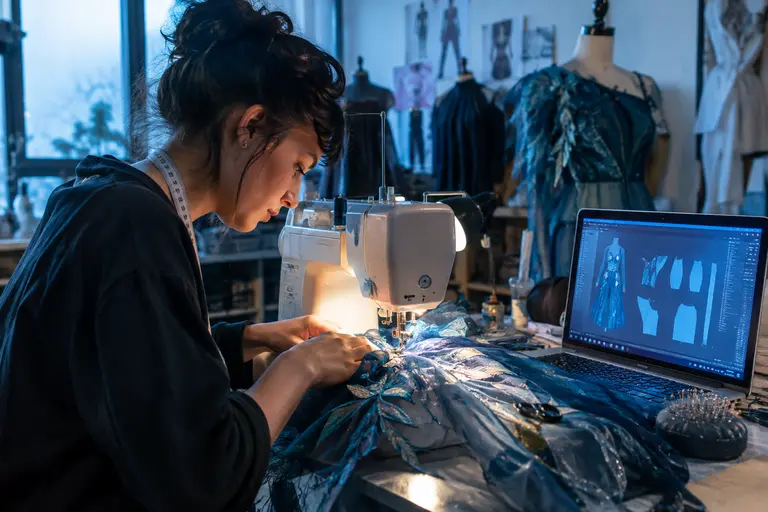
The research notes state that some works by Nettrice Gaskins use generative AI methods, including text-to-image and neural style transfer, while many other works in the exhibition do not use AI. That mix invites caution rather than panic. Costume audiences should ask what a tool contributes to the image, how the work is credited, and whether the final presentation respects the cultural material it invokes.
Why Tool Choice Changes Costume Reading
In fairytale costuming, handwork often carries emotional authority: the sewn hem, painted surface, repaired crown, or inherited cloak. Digital processes can carry meaning too, but they need clear framing. If an artwork uses AI to speculate on future bodies or carnival forms, that method becomes part of the artwork’s story. If a wearable piece relies on sewing, assemblage, or material experiment, the body of labor is read through texture and construction. Neither category should be treated as a shortcut to authenticity.
This is also where rights and likeness concerns enter the room, though not as legal certainty. Costume makers who sell speculative pieces should avoid copying living artists’ identifiable works, exhibition pieces, or protected characters. The safer creative path is to study principles: reflective contrast, modular layering, generous sizing, symbolic color, and nonbinary styling. For color-focused makers, our related essay on museum color theory offers a useful parallel without asking anyone to reproduce a specific artist’s design.
Women Of Afrofuturism And Afrofuturist Costumes
Women of Afrofuturism matters for fairytale costume study because it treats fantasy as cultural argument. Afrofuturist Costumes here are not escapist props floating free of history. They gather science fiction, myth, Black women’s creative labor, technology, ritual, and apparel into images of possible futures. For curators, parents, makers, and teachers, the lesson is not to borrow surfaces carelessly. The lesson is to build costume systems that make more people visible.
That approach can be quiet: a larger cape, a neutral tunic, a helmet that fits textured hair, a storage bin that welcomes repeated reinvention. Fantasy becomes inclusive when the wearer is not forced to shrink into a preset role. At its best, this exhibition shows costume as a form of authorship: the body steps into the story, and the story makes room.