

Dress-Up Play Benefits can offer a grounded way to think about children engaging with the artistic themes of Conduits of the Unseen. The research supplied does not identify the exhibition’s venue, artists, dates, curators, or individual works, so any costume-based response should be framed with care. The title suggests ideas of perception, symbolism, passage, and invisible forces, but those suggestions are not a substitute for the exhibition text or artist statements. A respectful dress-up approach should avoid copying specific artworks or presenting borrowed visual language as original design. Instead, it can help children test abstract ideas through fabric, gesture, role, sound, and story.
Dress-Up Play Benefits As Art Interpretation
Why Symbolic Costume Can Help Abstract Thinking
Art with unseen or symbolic themes can feel distant to children if the only available response is verbal explanation. Costume play gives the body a role in interpretation. A child might use a translucent scarf to suggest air, a cardboard ring to mark a portal, or a soft hood to represent secrecy. These are not claims about the exhibition’s actual objects. They are low-cost interpretive tools that let a young viewer ask, “What might be hidden?” or “How does something invisible become felt?”
A 2026 longitudinal study followed 230 Chilean children aged 4 to 7 from 2022 to 2024 and reported that higher-quality fantasy in pretend play predicted membership in an accelerated creativity-growth trajectory; about 22.3% of children followed that path, with stronger expressive and receptive language and divergent thinking by first grade, according to the pretend play study. That evidence does not prove that every exhibition costume activity will raise creativity. It does, however, support a cautious view that fantasy quality matters more than decorative excess.
Dress-Up Play Benefits And Symbolic Roles
Dress-Up Play Benefits are strongest when the role is open enough for children to revise it. A fixed costume that says “you are this one character” can narrow the response. A looser prompt, such as “be a messenger for something no one can see,” leaves room for invention. In relation to Conduits of the Unseen, that openness is useful because the supplied materials emphasize artistic themes rather than named characters, scenes, or plot points.
Respect for artistic integrity starts with this distinction: children can respond to mood, structure, contrast, and symbolism without imitating a specific living artist’s hand. A parent or educator might ask children to choose one material property, such as opacity, weight, reflection, softness, or shadow. The child then builds a role from that property. This keeps the activity analytical and playful, rather than turning the exhibition into a costume-copying exercise.
Language, Props, And Loose Parts
How Dress-Up Clothes Support Words
The supplied research also connects dress-up materials with language. A systematic review on indoor loose parts play reported that dress-up clothes and toy houses elicited more dramatic play, and that dramatic play was strongly associated with children using a larger number of different words, as discussed in the loose parts review. For an exhibition built around unseen ideas, that point is practical. Children often need words for sensations and relations: covered, revealed, passing through, behind, echoing, guarded, changing.
The props do not need to be elaborate. In fact, plain materials may leave more interpretive space than highly finished outfits. Gauze, ribbon, plain capes, paper cuffs, cardboard keys, fabric tubes, and masks without character likenesses can invite children to name what they are doing. A child who says, “This scarf is the wind carrying a message,” is practicing metaphor, sequence, and perspective. Those speech acts matter because the costume is not just an object; it becomes a prompt for narration.
For families building a home setup after an art visit, a small rotation of neutral props is often more useful than a bin full of recognizable commercial characters. The same principle appears in related site coverage of dress-up at art events, where guided play is treated as an interpretive aid rather than a substitute for the art. Readers interested in comparing similar creative approaches in arts-play contexts can explore detailed discussions on the related site in the same network.
Designing Costumes Without Overstating The Evidence
What The Research Can And Cannot Say
Dress-Up Play Benefits should not be presented as a guaranteed educational outcome. The strongest facts in the supplied research point to associations and developmental patterns in pretend play, creativity, language, and emotional regulation. They do not establish that one exhibition, one costume rack, or one workshop will produce measurable gains for every child. Age, class context, facilitation, access to materials, confidence, sensory preference, and peer dynamics can shape the result.
That caution matters for Conduits of the Unseen because abstract art can invite adult over-explanation. A child does not need to decode every curatorial idea to benefit from imaginative response. A better goal is disciplined openness: let the child form a hypothesis through movement and costume, then ask for evidence from what they noticed. “What made your cloak feel like a signal?” is more useful than “What does the artwork mean?”
Practical Boundaries For Respectful Design
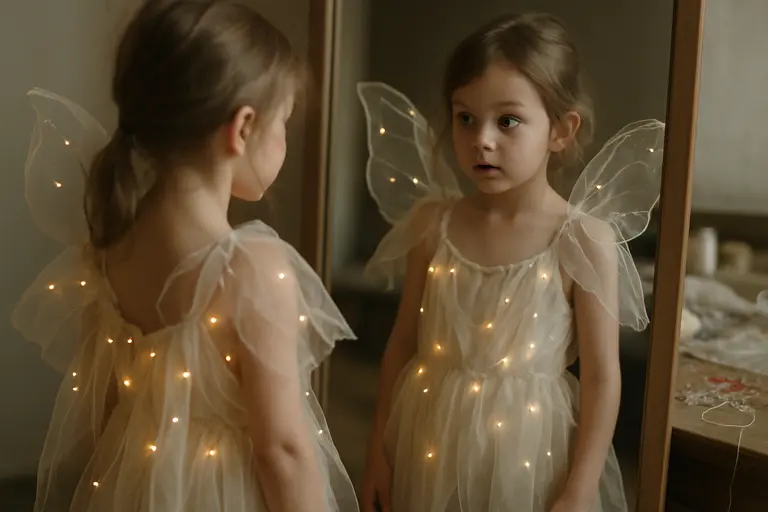
Costume design should avoid using protected character likenesses, celebrity faces, or direct copies of artworks as templates. This is not legal advice; it is a practical ethical boundary for home, classroom, and creator settings. Fairytale dress-up can draw on broad devices such as veils, thresholds, keys, lantern forms, wings, crowns, and messenger bags without claiming ownership over the exhibition’s visual language. The aim is response, not replication.
- Use material prompts: sheer, opaque, heavy, light, reflective, rough, or soft fabrics can stand in for unseen forces.
- Ask role questions: invite children to become a guide, signal, guardian, echo, witness, or messenger.
- Keep references broad: respond to themes and sensations rather than copying a specific artwork.
- Build in speech: ask children to name what their costume hides, reveals, carries, or protects.
- Allow refusal: some children may prefer drawing, arranging props, or narrating without wearing items.
Fairytale Costume Design For Unseen Themes
From Fairytale Motifs To Exhibition Response
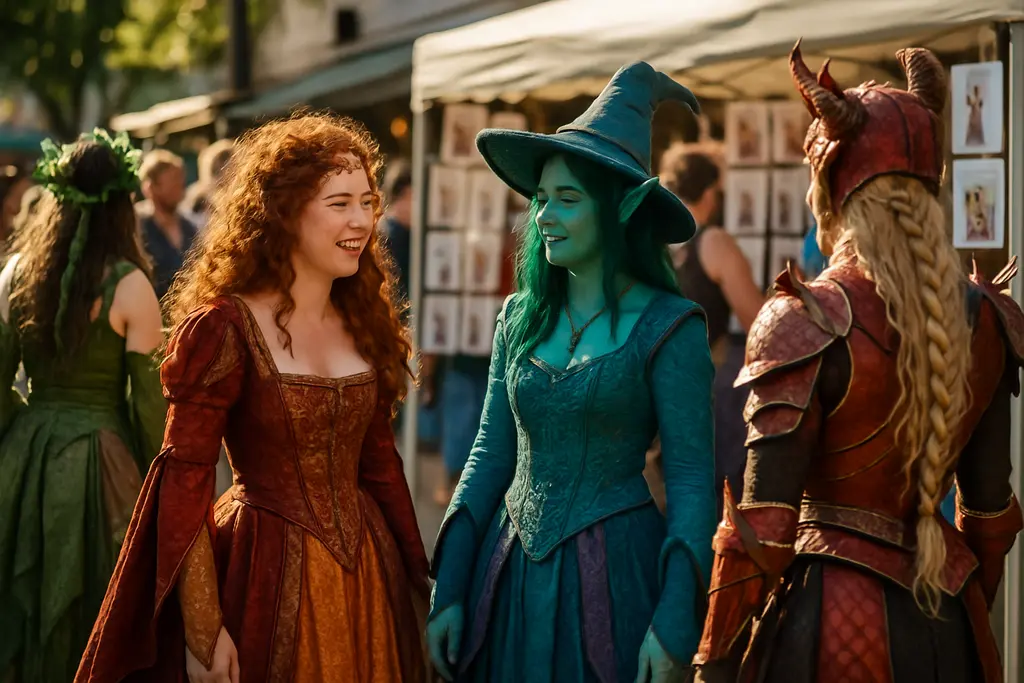
Fairytale fashion works well here because fairytales often use visible signs for invisible pressures: a cloak for secrecy, a key for access, a crown for responsibility, a forest edge for uncertainty. Those motifs should be treated as general cultural devices, not proof of what Conduits of the Unseen contains. A careful designer can use them to build costumes that feel interpretive without becoming illustrative copies.
The strongest Dress-Up Play Benefits in this context come from restraint. A silver paper collar might suggest a conduit more effectively than a fully literal “spirit” outfit. A child carrying three fabric strips can invent rules for what each strip transmits: memory, sound, or warmth. This kind of costume asks the child to connect object, rule, movement, and language. It also leaves the original artwork intact, rather than reducing it to a craft pattern.
For group play, the facilitator can assign linked roles. One child is the hidden message, one is the conduit, one is the listener, and one is the interrupter. The costumes can mark those roles with simple differences in texture or shape. The interpretive value comes from how the children negotiate the rules: who may pass through, what is blocked, what changes form, and what remains unseen. Those negotiations align with the research emphasis on quality of fantasy, language use, and social exchange.
Conduits Of The Unseen Dress-Up Reading
Because the supplied exhibition information is limited, the safest reading treats Conduits of the Unseen as a prompt for symbolic engagement rather than as a set of verified claims about artworks. Dress-Up Play Benefits can support that engagement when the activity is guided, open-ended, and respectful. The evidence supports links between pretend play quality, creativity trajectories, language use, and dramatic play materials, but it does not support exaggerated promises.
A well-built dress-up response should help children ask better questions: What can be sensed but not seen? What carries a message? What changes when it passes through a body, fabric, doorway, or story? In that careful frame, costume becomes a thinking tool. It helps young viewers translate abstract artistic themes into movement, speech, and shared invention while leaving the original exhibition’s artistic integrity in place.