
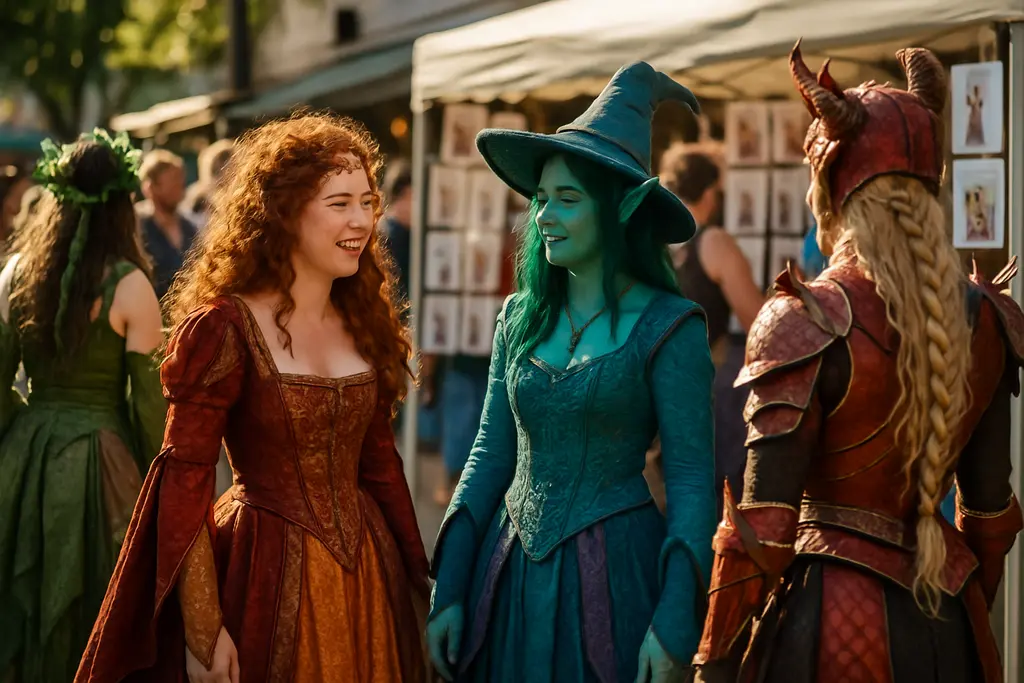
Fantasy Street Costumes begin in that bright alley where a cloak meets a hoodie, where boots remember cobblestones, and where a maker must still sew a sleeve that lets the arm move. Treated here as an aesthetic prompt rather than a command to copy a protected world, logo, or character, the idea works best when it joins streetwear logic with fantasy proportion. As of September 16, 2026, Halloween 2026 and many fall costume gatherings remain ahead, so the useful question is not whether the look photographs well once. The useful question is whether the pattern holds through stairs, crowds, cold air, and a long night.
Fantasy Street Costumes And The Pattern Brief
The phrase can tempt a creator into piling every possible sign of fantasy onto one body: horns, cape, belt pouches, corset lacing, embroidered borders, metal paint, torn hems, and giant sleeves. That approach often reads as costume noise. A stronger design brief chooses one dominant silhouette, one practical garment base, and one symbolic motif. The street half of the formula needs pockets, washable zones, and shoes that can survive pavement. The fantasy half can arrive through scale, texture, collar shape, trim placement, or an altered hood.
Fantasy Street Costumes As A Design Prompt
Fantasy Street Costumes should not depend on direct imitation of a specific film character, living artist, game skin, or celebrity outfit. The safer artistic route is abstraction: a crescent-shaped yoke instead of a copied emblem, a thorn-like sleeve seam instead of a trademarked armor plate, or a weathered tabard layered over a plain bomber. That distinction matters for aspiring sellers. Fan culture has its own customs, but commercial costume work should be approached with care, rights awareness, and clear original authorship. This is not legal advice; it is a practical design warning from the cutting table.
Evidence Before Ornament
A 2026 costume trend report lists fantasy- and mythology-inspired costumes among fast-growing Halloween categories beside superheroes and villains, according to Fantasy Costumes. That source is a retail trend page, so I would treat it as market direction rather than neutral academic measurement. Still, it supports a reasonable planning assumption: fantasy styling has enough consumer attention to justify printable patterns, small-batch accessories, and tutorial content. The stronger product is not the loudest costume. It is the one a beginner can cut, test, alter, and finish before October 31, 2026.
Pattern Drafting Before The Glitter
The first act is not buying faux leather or metallic paint. The first act is drawing the body map. A costume pattern must decide where the body bends, where weight hangs, and where decorative cloth can sit without dragging the garment out of shape. If the base is wrong, every jewel glued to it becomes a tiny lamp illuminating the error.
The Sloper Is The Lantern
An August 2, 2026 pattern-making tutorial recommends drafting a base block or sloper, adding style lines such as darts, pleats, and panels, then choosing fabrics according to costume function, as described in this costume pattern guide. That sequence is sound. For Fantasy Street Costumes, the sloper lets the maker keep the streetwear layer credible. A hooded jacket can be traced from a bodice block. A split overskirt can be hung from a fitted waistband. A capelet can share shoulder measurements with the jacket beneath it, avoiding the sad shoulder collapse that makes many handmade costumes look tired before dusk.
Streetwear Fit And Wearable Volume
Streetwear is not just a mood; it is a fit system. Drop shoulders, elastic cuffs, roomy knees, and layered hems all change how a costume behaves. Fantasy volume must be rationed. If the upper body carries a tall collar and hood, keep the trouser shape calmer. If the skirt is wide, shorten or narrow the cape. I would test any large sleeve with three tasks: reaching a phone, lifting a cup, and opening a door. If the sleeve fails those tests, the pattern is not event-ready, however beautiful it looks on a dress form.
Materials, Motifs, And Respectful Borrowing
Fabric is the weather of a costume. It tells the skin whether the day will be kind. For a fantasy street look, I would place comfort fabrics near the body and theatrical fabrics at the edge. Cotton jersey, ponte, twill, or sweatshirt fleece can carry the garment. Organza, jacquard scraps, brocade bands, faux suede, or painted canvas can speak in a more enchanted accent without turning the whole outfit into a furnace.
Fabric Choices That Behave In Public
Creators should rank fabric by use, not just beauty. A cape lining must slide over the garment beneath it. A corset-style vest needs enough structure to hold a shape but not so much stiffness that the wearer cannot sit. Metallic vinyl can crack at stress points, so it often works better as trim than as a full sleeve. If armor is needed, foam or quilted panels may be kinder than heavy rigid pieces for a crowded event. A pattern that marks grainline, stretch direction, and stress points gives beginners a better chance than one that only offers dramatic photos.
- Use a plain base garment first: hoodie, vest, skirt, trouser, or capelet.
- Add one fantasy structure: pointed hood, split overskirt, shaped collar, or bracer cuff.
- Repeat one motif in three places: hem, cuff, and bag strap are enough.
- Test movement in muslin or scrap fabric before cutting the final cloth.
Motifs Without Copying A Living Artist
Respectful borrowing starts with naming the difference between influence and imitation. A maker can study medieval tailoring, folklore symbols, festival clothing, and streetwear proportion without copying an identifiable contemporary artwork. For broader creator reading within the same network, Next Clues offers adjacent cultural coverage, providing additional insight and inspiration. Fairytale makers considering original concepts may also find value in this discussion of original fantasy world-building. The practical rule is simple: let research feed structure and mood, not replication.
Testing Tutorials And Printable Patterns

A printable costume pattern is a product, not a spell. It deserves to be judged by evidence: size range, seam allowance notes, tiling instructions, fabric suggestions, alteration points, and finished garment measurements. A tutorial should show the awkward middle stages, not just the shining finish. Beginners need to see clipped curves, pressed seams, failed mockups, and the reason a dart moved half an inch.
What A Good Tutorial Should Prove
For Fantasy Street Costumes, a useful tutorial proves that the garment can be worn with modern movement. The photos or diagrams should show the closure, inner support, pocket access, and back view. If a cape attaches to a collar, the tutorial should explain how that weight is supported. If a skirt has panels, it should show how those panels hang when walking. If appliqué files are included, the maker still needs guidance on fabric stability, needle choice, and whether the appliqué edge will fray.
Product Review Criteria For Aspiring Sellers
I would grade a fantasy street pattern on five points. First, the base block must be clear enough for alteration. Second, the style lines must serve the silhouette rather than decorate randomly. Third, the instructions must separate beginner steps from advanced options. Fourth, the file should print cleanly and label every piece. Fifth, the design should be original enough for a seller to describe honestly without leaning on another creator’s audience. A pattern that satisfies those points is not merely pretty; it is teachable.
Fantasy Street Costumes For October 2026
The strongest plan for October 2026 starts small and finishes early. Choose the base garment by September 20, cut a test version by September 27, adjust the fit by October 4, sew the main garment by October 15, then leave the final stretch for trim, weathering, and repairs. That schedule is less romantic than a midnight rush, but cloth rewards patience. The moon may rise on Halloween, yet the sleeve still needs a clean armscye.
A Practical Event Build Schedule
For makers preparing Fantasy Street Costumes, the winning design is often modular. A hood, vest, belt, and cuff set can change a plain black outfit into a plausible street-fantasy character without demanding a full gown or armor build. Modular work also helps sellers: one pattern can support several variations if the instructions explain which pieces are essential and which are optional. That clarity gives beginners freedom without abandoning them in a fog of choices.
The final measure is bodily truth. Can the wearer sit, breathe, walk, carry a bag, and mend a loose snap? If yes, the costume has earned its magic. If no, the design remains a drawing wearing fabric. Fantasy belongs in the air, but patterns belong to gravity; the best maker learns to serve both.