
The Silk Road Redefined: Decoding the Guochao Phenomenon and the Neo-Chinese Sartorial Awakening
For the better part of the late twentieth and early twenty-first centuries, the global fashion industry operated under a rigid, Eurocentric hegemony. Paris, Milan, London, and New York dictated the silhouettes, the seasonal palettes, and the overarching definitions of luxury. Meanwhile, China was largely relegated to the role of the global factory floor—a vital engine of industrial mass production, but rarely acknowledged as a crucible of original design. Today, a seismic ideological and economic shift is entirely dismantling that outdated paradigm.
Driven by a fierce resurgence of cultural pride, an immense accumulation of domestic wealth, and the hyper-connected digital fluency of Generation Z, the Chinese fashion landscape is undergoing a profound structural renaissance. This is not a fleeting seasonal trend; it is a meticulously engineered reclamation of millennia of sartorial history. At the epicenter of this transformation lie three intersecting phenomena: the overarching consumer philosophy of Guochao, the rigorous historical restoration of Hanfu, and the avant-garde, bicultural synthesis known as the Neo-Chinese aesthetic. Together, these movements are proving that ancient heritage can seamlessly dictate contemporary global luxury, fundamentally altering the trajectory of the international apparel market.
The Economic and Cultural Mechanics of Guochao
To comprehend the modern Chinese fashion ecosystem, one must first analyze the macroeconomic framework of Guochao. Translating directly to “national trend” or “China chic,” Guochao represents a massive shift in consumer psychology that began to gain measurable commercial momentum around the turn of the last decade. Historically, upwardly mobile Chinese consumers signaled their socioeconomic status almost exclusively through the acquisition of Western luxury legacy brands. However, as the nation’s economic superpower status solidified, a new generation of consumers emerged—one that feels no innate subservience to Western validation.
This demographic is actively divesting from European fast fashion and legacy houses, choosing instead to inject their capital and cultural cachet into domestic brands that reflect their own complex, localized identities. This pivot is deeply analytical. Modern consumers no longer associate the “Made in China” label with rapid, low-quality industrial manufacturing. Instead, the label is being aggressively reclaimed as a powerful indicator of authentic, localized innovation and high-level craftsmanship.
The economic weight of Guochao is staggering, capturing billions of dollars in domestic retail revenue and forcing international conglomerates to completely restructure their Asian market strategies. By elevating Chinese heritage from a seasonal novelty to a core component of innovative design, domestic brands are securing a fiercely loyal consumer base that values cultural resonance just as highly as material quality.
Architectural Precision: The Anatomy of the Hanfu Revival
While Guochao provides the broad economic canopy, the Hanfu movement represents the hyper-specific, historical heartbeat of this cultural renaissance. Hanfu encompasses the traditional clothing systems worn by the Han Chinese populace across several major imperial dynasties, standing in stark contrast to the Manchu-derived qipao (cheongsam) that dominated Western perceptions of Chinese dress throughout the twentieth century.
What distinguishes the modern Hanfu revival from whimsical cosplay or theatrical costuming is its strict, almost academic adherence to historical accuracy. Enthusiasts treat these garments as living artifacts. The structural components of Hanfu are marvels of textile engineering that eschew modern Western tailoring techniques, such as darts and rigid structural interfacing. Instead, the iconic cross-collar design, known as the jiaoling youren, utilizes precise geometric folding to contour the human body. Rather than relying on zippers or rigid buttons, these garments employ intricate fabric sashes that distribute weight evenly across the torso, allowing the wide, diaphanous sleeves to move with fluid, deliberate aerodynamics.
The revival is heavily segmented by dynastic eras, each offering distinct silhouettes that appeal to different modern sensibilities. The Tang Dynasty aesthetic, characterized by high waistlines, flowing ribbons, and vibrant, multi-colored layers, appeals to those seeking opulence. In contrast, the Song Dynasty style offers a more restrained, slender profile utilizing muted tones, aligning perfectly with modern minimalist trends. Meanwhile, the Ming Dynasty aesthetic, famous for the mamianqun (horse-face pleated skirt) and heavier, intricately embroidered jackets, provides a sense of structured formality.
On the bustling streets of contemporary metropolises like Shanghai, Chengdu, and Beijing, these historical silhouettes are no longer confined to cultural festivals or lunar holidays. They are routinely integrated into daily life, paired with modern sneakers, minimalist jewelry, and contemporary styling. This striking visual dichotomy effectively normalizes historical dress in everyday urban environments, facilitated largely by digital platforms like Xiaohongshu and Douyin, where billions of views are dedicated to styling tutorials, historical debates, and artisan spotlights.
The Bicultural Lens: Defining the Neo-Chinese Aesthetic
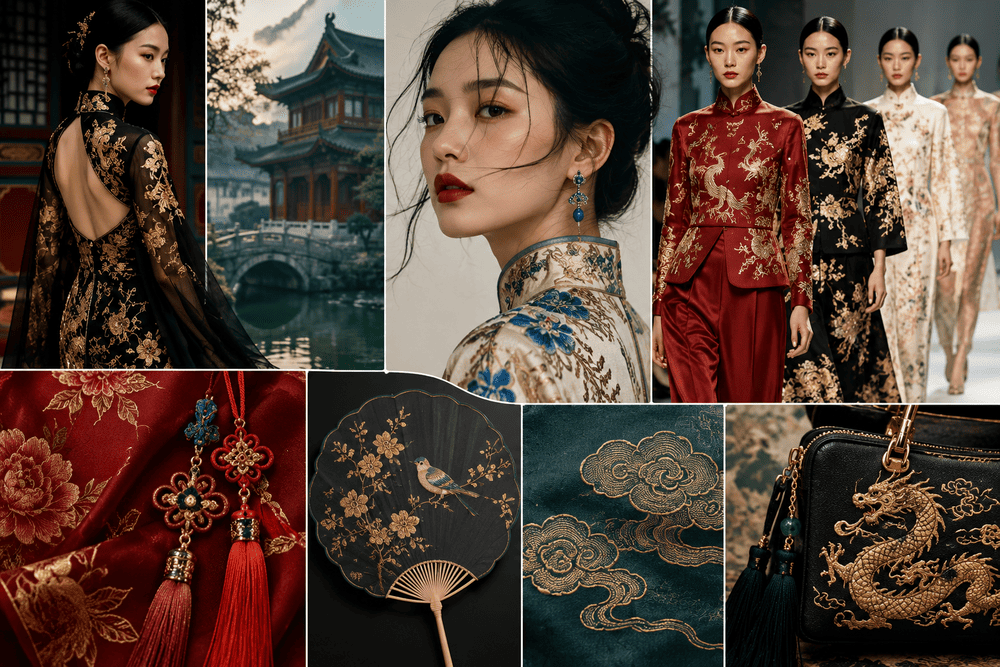
While the Hanfu community strictly preserves historical parameters, the Neo-Chinese (often referred to as Xinzongshi) movement operates as an exercise in architectural deconstruction and cultural hybridity. This aesthetic is particularly potent among the global Chinese diaspora and the highly educated, internationally traveled youth demographic. It functions as a tangible, wearable bridge between ancestral heritage and modern cosmopolitan life.
Neo-Chinese fashion does not seek to replicate the past. Instead, it strips traditional garments down to their elemental codes—the asymmetric knot of a frog closure, the subtle curve of a mandarin collar, the specific drape of a raglan sleeve, or the textural weight of raw silk—and grafts them onto Western silhouettes. Pioneering designers such as Samuel Gui Yang, Ms MIN, Shushu/Tong, and Vivienne Tam are the vanguards of this bicultural synthesis.
A quintessential Neo-Chinese collection might feature a meticulously tailored, gender-fluid blazer constructed from traditional rice paper textiles, or a utilitarian, cyberpunk-inspired bomber jacket fastened with intricate, hand-woven Ming-era knotting. This design philosophy directly influences the broader global narrative of Chinese fashion evolution, compelling international luxury houses to rethink how cultural heritage is interpreted on the runway. It allows the wearer to project a deeply rooted cultural identity without sacrificing engagement with international modernity, creating a sartorial language that is universally legible yet culturally specific.
Master Artisans and the Engineering of Heritage Textiles
The authenticity of the Neo-Chinese movement is anchored not just in silhouette, but in materiality. The revival of ancient textile engineering is a cornerstone of this fashion renaissance. For decades, highly specialized fabric production techniques were pushed to the brink of extinction by the demands of rapid industrialization. Today, these heritage textiles are experiencing a massive resurgence in demand, commanding premium prices that rival European heritage fabrics like Scottish tweed or Italian cashmere.
Designers are actively partnering with local artisans to revive complex weaving, dyeing, and embroidery techniques. This includes the utilization of Song brocade, known for its extreme durability and intricate geometric patterns, and the highly sought-after Xiangyunsha (gambiered Guangdong silk). The latter is a marvel of ancient chemistry, dyed with the juice of the dioscorea cirrhosa plant and coated with iron-rich river mud to create a fabric that is antibacterial, water-resistant, and boasts a unique, leathery luster. The incorporation of these materials is a testament to the intersection of luxury and sustainable silk production, proving that ancient ecological practices hold immense value in the modern, climate-conscious market.
| Textile Innovation | Regional Origin | Distinct Material Characteristics |
| Xiangyunsha (Gambiered Silk) | Guangdong Province | Dyed with plant extracts and river mud; antibacterial, water-resistant, dual-sided color profile. |
| Song Brocade | Suzhou | Complex, interlocking geometric weaves; highly durable, traditionally used for mounting scroll paintings. |
| Kesi (Cut Silk) | Yangtze River Delta | Tapestry weaving technique creating reversible, seamless patterns; extremely labor-intensive (“an inch of Kesi is an inch of gold”). |
| Summer Cloth (Ramie) | Jiangxi / Hunan | Woven from nettle plant fibers; highly breathable, crisp texture, utilized for lightweight, structured summer garments. |
Navigating the Global Luxury Market: Appreciation Versus Appropriation
As the financial viability and cultural dominance of the Guochao movement become undeniable, Western luxury brands are aggressively attempting to capture a share of the market. However, modern consumers possess an incredibly low tolerance for superficial engagement or intellectual laziness. The era in which a European house could simply print a red dragon or a zodiac animal onto a standard handbag capsule for the Lunar New Year and expect immediate commercial success has definitively ended.
Today, such superficial attempts are routinely met with critical backlash on social media, resulting in severe commercial failure and brand degradation. The modern, heritage-conscious consumer is highly attuned to the nuance between genuine cultural appreciation and extractive cultural appropriation.
The analytical path forward for international brands requires deep, structural integration rather than surface-level homage. True commercial success within the Neo-Chinese ecosystem relies on authentic collaboration with native designers, local artisans, and cultural historians. Brands must engage with the semiotics embedded within the textiles and silhouettes. By partnering with the vanguards of the Neo-Chinese movement, Western houses can navigate the complex cultural landscape with respect and innovation, transforming potential public relations liabilities into dynamic, cross-cultural design partnerships.
The Future Trajectory of Eastern Aesthetics
The rise of Guochao, Hanfu, and Neo-Chinese fashion is not merely a cyclical trend; it is a permanent realignment of the global fashion axis. Shanghai has undeniably cemented its status alongside Paris and Milan as a premier global fashion capital, generating trends that ripple outward to influence global design.
As the Neo-Chinese movement continues to mature, it is aggressively exploring complex modern themes such as gender fluidity, urban utility, and intricate bicultural narratives. The designers spearheading this movement are proving that tradition is not a static museum piece to be passively observed, but a dynamic, living vocabulary capable of articulating the complexities of the modern world. The future of global fashion will inevitably be deeply interwoven with the threads of Chinese heritage, ensuring that the sweeping romance of ancient dynasties will continue to dictate the rhythm, structure, and philosophy of modern style for decades to come.