
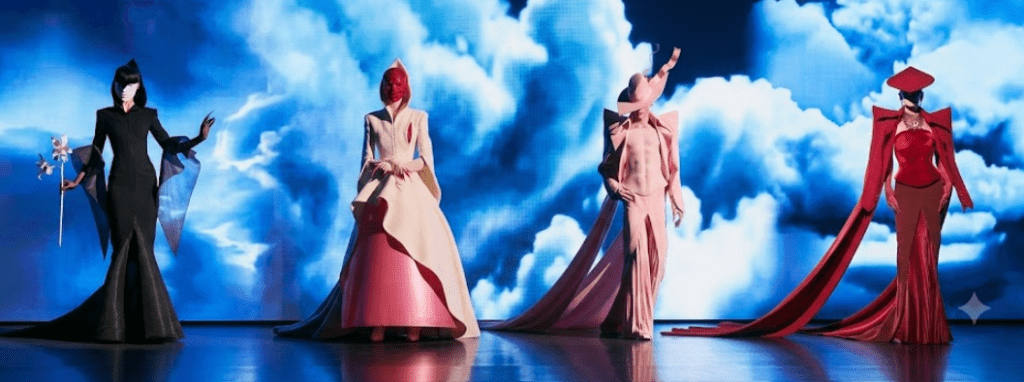
Robert Wun established a commanding presence within the global luxury sector by merging structural anatomy with cinematic narrative. For his Spring/Summer 2026 haute couture presentation, the London-based designer transformed the historic Théâtre du Lido in Paris into a site of psychological tension. Titled Valor: The Desire to Create, and the Courage to Carry On, the show replaced traditional couture fantasy with a calculated examination of artistic survival. Set against massive digital screens projecting rolling thunderstorms and lightning strikes, the collection explored the heavy physical and emotional toll of the creative process.
The presentation marked a definitive shift in Wun’s aesthetic trajectory. Where his earlier seasons often relied on intense surface embellishment and theatrical blood-splatter motifs, this season demonstrated profound structural restraint. The silhouettes appeared clearer, the gestures felt contained, and the raw materials communicated the designer’s intent through pure physical weight. The collection unfolded as a formal three-act narrative, dissecting the precise emotional stages of a creator: finding inspiration, confronting commercial reality, and summoning the endurance to continue.

Act I: The Library And The Origin Of Ideas
The first section of the presentation, titled “Library,” investigated the quiet, isolated genesis of creative thought. Wun drew direct inspiration from his own fashion school sketchbooks, originating during his time at the London College of Fashion in 2012. This era represented a period where his imagination operated entirely free from the burden of financial metrics and business constraints.
To visually represent this pure ideation phase, the initial garments utilized a strict black-and-white color palette. The designs focused heavily on severe, sculpted construction rather than decorative surface treatments. Models walked the runway in tightly fitted bodices and enormous, rounded bolero shoulders that established immediate architectural volume. Long, flared skirts provided a necessary structural counterbalance to the heavy upper body proportions.
These opening looks demanded absolute posture and control from the wearer. The strict tailoring and reduced color scheme forced the audience to evaluate the garments based entirely on their geometric lines and internal construction. This segment successfully established couture as an intellectual exercise, where ideas gain physical structure before they are exposed to the demands of the commercial market.
Act II: Luxury And The Economics Of Fashion
The second act, “Luxury: Confrontation of Reality,” addressed the uncomfortable economics of the fashion industry. Wun examined the arbitrary systems used to assign financial value to creative output. He critiqued the transition of art into commerce, designing garments that actively questioned the concept of the priceless object.
This conceptual framework resulted in some of the most striking physical garments on the runway. Models emerged wearing molded, rigid bodices designed to resemble the velvet-flocked display stands used in high jewelry boutiques. The human body became secondary, acting merely as a literal support structure to showcase extreme wealth. Wun paired these display-stand corsets with draped skirts featuring massive trailing trains, creating a deliberate tension between the rigid upper half and the fluid lower half.
The accessories in this section reinforced the theme of commercial objectification. Models wore face masks completely encrusted in crystals, a design choice that successfully erased their individual identities. The surface of these masks reflected the runway lighting like polished metal, sealing the face rather than decorating it. Wun effectively argued that the relentless pursuit of luxury often obscures the human element required to create it.

The Anabela Chan Joaillerie Collaboration
To execute the high-jewelry concepts of the second act, Wun collaborated with Anabela Chan Joaillerie, integrating massive, custom jewelry suites directly into the garments. The partnership produced over forty unique creations, utilizing 8,892 calibrated-cut, laboratory-grown gemstones.
Chan and Wun constructed suites inspired by historical royal jewels, incorporating lab-grown pigeon blood rubies, emeralds, lavender sapphires, and black diamonds. The “Lavender Valour Suite” alone featured 2,146 lavender sapphires totaling over 2,166 carats. These massive gem clusters were embedded into chokers, sautoir necklaces, tiaras, and architectural ear cuffs. By utilizing lab-grown stones rather than mined diamonds, the collaboration added a layer of modern material innovation to the traditional concept of opulence. The sheer scale of the jewelry anchored the heavy velvet and silk textiles, proving that high fashion accessories can function as integral structural components rather than simple add-ons.
Act III: Valour And The Weight Of Creation
The final act of the presentation shifted the focus back to the creator. “Valour” explored the internal struggles, doubts, and psychological pressures associated with maintaining artistic integrity in a demanding industry. Wun visualized this endurance by turning the concept of fashion as armor into a literal design directive.
Models carried physical weapons, treating swords and protective plating as metaphors for defense and psychological resilience rather than tools of violence. One model appeared in gleaming silver armor, holding a sword with practiced precision. Another wore a bodysuit printed with high-contrast, black-and-white anatomical sketches of a muscular human body, turning the biological frame into an external graphic display.
The contrast between protection and vulnerability defined the styling. A deep green molded chest piece left the midsection completely exposed, sitting directly above a voluminous white skirt. A white hooded gown layered over a red understructure provided another striking visual conflict. The white hood framed the head exactly like a defensive shield, while flashes of the red structure beneath suggested exposed internal tissue. This specific silhouette completely resisted fluid movement, reinforcing the heavy burden the garments placed upon the wearer.
| Narrative Act | Thematic Focus | Dominant Silhouettes & Materials |
| I: Library | The origin of ideas, pure imagination | Black and white tailoring, rounded bolero shoulders, strict architectural volume |
| II: Luxury | Commercial reality, the assignment of value | Molded display-stand bodices, crystal face masks, heavy lab-grown gemstone suites |
| III: Valour | Psychological endurance, defense | Literal silver armor, hooded shields, anatomical prints, heavy protective plating |
The 40-Kilogram Beaded Gown: An Exercise In Extreme Gravity
The absolute centerpiece of the Robert Wun Spring 2026 Couture collection arrived as a testament to technical extremity. Wun sent a circular gown down the runway entirely encrusted with micro glass beads. The garment weighed close to 40 kilograms, approximately 92 pounds. The dress matched the physical dimensions of a small adult human.
The sheer physical mass of the gown defined its movement. The model navigated the runway with slow, highly intentional steps, unable to disguise the immense physical burden of the dress. The weight became an active, visible component of the design. This garment encapsulated the entire thesis of the collection. It demonstrated the crushing, literal weight of creative ambition. The construction required massive atelier expertise, proving that Wun possesses the technical capability to execute garments at the highest possible difficulty level. By forcing a model to carry 92 pounds of glass beads down a runway, the designer forced the audience to acknowledge the intense physical labor required to produce authentic haute couture collections.
Textile Engineering And Fabrication Strategies
Wun treated fabrics exactly like architectural building materials throughout the show. The material analysis of the collection reveals a deep reliance on heavy, shape-holding textiles contrasting with strategic moments of fragile fluidity. The studio utilized structured satin, dense leather, and manipulated worsted wool to create pieces acting as protective carapaces.
Chiffon led the softer textile categories, providing ethereal motion against the rigid armor pieces. Pleated fabrics introduced mathematical rhythm to the skirts, while lace provided sharp, gothic romanticism. Wun frequently employed trompe-l’œil techniques and intense surface manipulation. Dresses featured large-scale floral prints and patterns applied against inky, dark backgrounds. The color palette relied heavily on midnight ink and porcelain blush, punctuated by flashes of garnet wine and crimson. The absence of bright, cheerful spring pastels confirmed the serious, existential tone of the entire presentation.
The collection relied entirely on long, dramatic hemlines. Maxi-length gowns and severe A-line cuts dominated the runway, commanding physical space and dictating a slow, regal walking pace. Sleeveless cuts exposed the arms, highlighting human vulnerability against the heavy, protective collars and molded chest pieces.
The Finale: Softness as a Deliberate Choice
After a relentless sequence of armor, heavy glass beads, and structural defense mechanisms, the final look shifted the tone of the presentation. A model emerged from the artificial storm wearing a voluminous white dress heavily adorned with delicate fabric butterfly elements.
The garment appeared lighter and more open than the preceding looks, but the execution remained entirely precise. The softness of the butterflies did not read as simple ornamentation. Set against the aggressive context of the rest of the show, this fragile finale felt like a deliberate, highly calculated decision. The designer offered a moment of quiet contrast rather than a complete release of tension. The figure crossed the runway slowly before disappearing into the darkness of the stage, closing a highly demanding performance.
A Defining Moment For Modern Couture
The Robert Wun Spring 2026 Couture collection forced fashion critics to evaluate garments through the lens of psychological strain and extreme physical architecture. The designer successfully argued that high fashion survives precisely because it reflects internal human struggles. Wun ignored the commercial demand for easily digestible, red-carpet-ready gowns. He delivered a collection focused on narrative depth, proving his ability to compete directly with the heritage brands dominating Paris Fashion Week.
The industry will study the construction of the 40-kilogram beaded gown and the molded jewelry bodices for years to come. By prioritizing structural integrity and emotional gravity over simple aesthetics, Robert Wun set a demanding new standard for the global couture market. The presentation verified his position as a master of modern avant-garde design, cementing his legacy as a designer who builds permanent, striking architecture out of raw fabric and human ambition.