
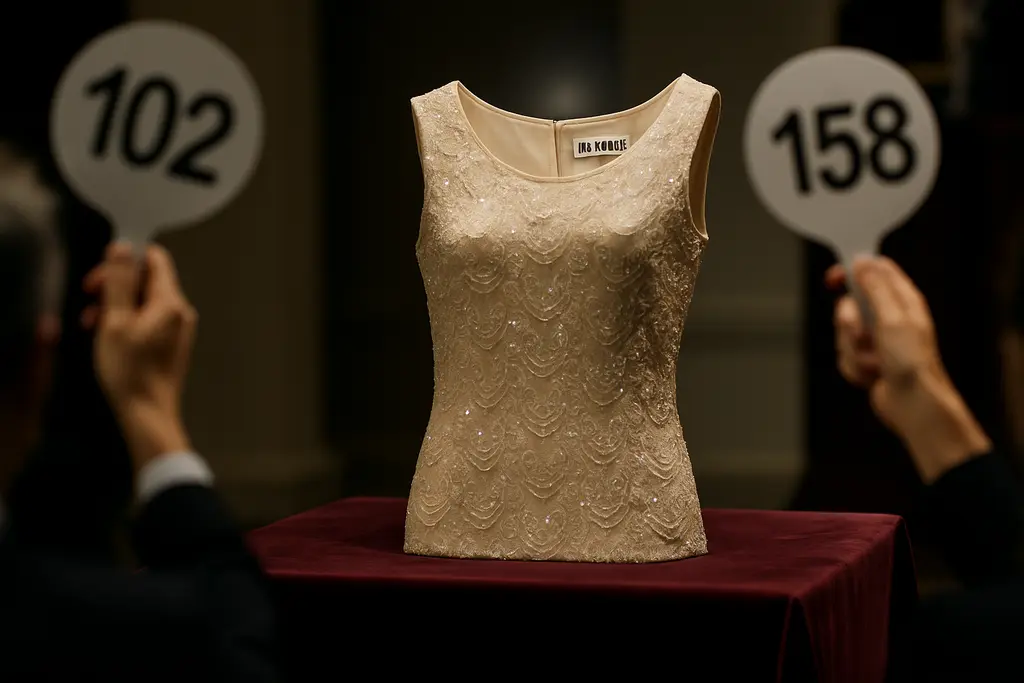
Fashion Brands To Watch deserves a careful reading after Christie’s staged “Bill Blass: American Elegance” around New York Fashion Week in September 2026. The online auction was scheduled for September 9–23, 2026, with exhibitions held September 8–13 at Rockefeller Center and September 18–22 at the Bill Blass townhouse in New York, according to Christie’s. On September 23, 2026, the useful question is not whether one sale can revive a label by itself. It cannot prove that. The stronger question is what an archive sale reveals about design memory, buyer education, and the brands that may benefit from clearer historical framing.
Auction Evidence Before Brand Hype
What The Sale Actually Contained
The Bill Blass auction offered 129 lots, including more than 100 garments, sketches, and letters connected with public figures and industry names including Nancy Reagan, Barbara Walters, Ralph Lauren, Armani, Geoffrey Beene, Elsa Schiaparelli, and Diane Vreeland, as reported by Artnet News. Peter Som, a former Creative Director of Bill Blass, curated the auction and archive pieces, with the clothing focused mainly on work from the 1980s and 1990s. The garment mix was described as roughly 60 dresses, 20 coats or jackets, and 30 suits or sets.
Those figures matter because they show an archive large enough to demonstrate range rather than a small nostalgia edit. A dress-heavy offering places eveningwear and social dressing at the center of the Blass record, while coats, jackets, suits, and sets give buyers a view of daywear polish. For fashion analysis, that balance is valuable. It allows one to compare the designer’s formal glamour against the quieter structure of tailored separates without pretending that either category explains the whole brand.
Estimates As Cultural Signals
Several highlighted lots were especially useful for reading the sale. Christie’s noted a Spring/Summer 2004 ready-to-wear multi-colored gown identical to one Beyoncé wore, a Spring 1988 sequin-embroidered “Matisse” cocktail dress estimated at USD $2,000–$3,000, and a 1960s multi-colored floral silk dress coat from Bill Blass for Maurice Rentner estimated at USD $1,000–$2,000. The estimates supplied in the research suggest that archival American fashion can appear within an auction environment without being priced only as trophy material.
That price accessibility, however, should not be confused with guaranteed future value. No final realized prices were supplied in the research brief. Without hammer prices, bidder counts, and condition notes for each lot, it would be premature to state that the market has repriced Bill Blass. A cautious reading is more useful: Christie’s placed the archive in a high-visibility cultural setting, and the sale structure made Blass legible to collectors who may have known the name but not the garment categories.
Fashion Brands To Watch After The Blass Sale
Fashion Brands To Watch In Archival Context
Fashion Brands To Watch often share one trait: they can be explained through objects, not only through marketing language. Bill Blass benefits from that standard because the research points to dresses, coats, jackets, suits, sketches, letters, and known social references. This is a different kind of evidence than a seasonal campaign. It gives collectors and stylists a physical vocabulary: sequins, florals, silk, evening silhouettes, and a polished American social register.
The Christie’s framing also points to the importance of lifestyle branding. The research notes that Blass’s legacy extended beyond couture into licensing that included swimwear, luggage, perfume, and even chocolate. That breadth should be interpreted carefully. Licensing can strengthen name recognition, but it can also blur the public memory of a designer if the design codes become less visible than the products carrying the label. For a brand entering renewed archival attention, the challenge is to make the strongest garments visible enough to guide the story.
From that viewpoint, Bill Blass belongs on a restrained watchlist. The rationale is not sudden hype. It is the combination of a major auction platform, a sizable archive offering, recognizable social history, and estimates that may invite study by collectors outside the highest luxury tier. For readers comparing fashion display, commerce, and authorship, our review of Eckhaus Latta’s retail installation offers a useful parallel: presentation context can affect how clothes are read, even when the garments remain the primary evidence.
Resale Signals Without Overclaiming
Legacy Houses And Stable Recognition
The research brief also lists broader resale signals as of September 2026. It states that Louis Vuitton, Gucci, Burberry, and Chanel topped global purchases in eBay’s Q1 2026 Watchlist, while other market analytics pointed to stable demand around Louis Vuitton, Gucci, Chanel, Prada, and Dior. Those names are not surprising. Their value in a watchlist lies in their continuing recognition, not in novelty. They function as anchors against which smaller surges can be compared.
For Fashion Brands To Watch, that distinction matters. A legacy house with steady demand may be important for resale confidence, while an archive-backed American name such as Bill Blass may be important for discovery and education. The two cases are not equivalent. Chanel or Louis Vuitton carries broad visual recognition across bags, ready-to-wear, and accessories. Bill Blass, based on the research supplied here, is being reconsidered through auction objects and documented archive material. One offers market familiarity; the other offers a case study in renewed attention.
Growth Names Need Context
The broader research also named Rodarte, Raf Simons, Aupen, and Blumarine as brands with substantial average sale-price growth in eBay’s Q1 2026 Watchlist, with Rodarte listed at +721%, Raf Simons at +384%, Aupen at +317%, and Blumarine at +298%. Other notes cited Coach searches up 160%, Salvatore Ferragamo up 129%, and Pucci up 110% year over year in resale searches. KURB’s Q2 2026 report, as provided in the brief, listed Khaite at +106.4%, Enfants Riches Déprimés at +98.5%, and Geoffrey B. Small at +95.3% among fastest-rising apparel brands on resale platforms.
These numbers are useful, but they need restraint. Search growth is not the same as completed sale strength. Average sale-price growth can be affected by product mix, rarity, and small sample sizes. Price growth on resale platforms can point toward demand, but it does not automatically tell a buyer whether a specific garment is well made, fairly priced, or likely to hold interest. The strongest lesson from the Blass sale is that names become more persuasive when their objects can be studied in detail.
DIY Dress-Up Lessons From Archival Fashion
Study Proportion, Not Replication
For DIY dress-up and creator-commerce readers, the Bill Blass archive offers a disciplined lesson: study proportion, finish, and styling logic rather than copying a specific garment. A sequin cocktail dress, a floral silk dress coat, or a polished suit set can inspire questions about scale, surface, and occasion. Those questions are productive. Direct imitation of a protected design, especially for sale, raises rights and authorship concerns that creators should treat seriously and assess with qualified guidance when needed.
A respectful DIY approach might focus on general design principles visible in the research: evening shine balanced by controlled shape, a dress coat used as the central visual layer, or a suit set styled for social polish rather than office neutrality. That kind of analysis protects artistic integrity because it treats the original work as a source of study, not as raw material to be copied. For adjacent styling references and handmade presentation ideas, a related network resource such as Shimply can provide additional insights into the context of auction research without replacing primary evidence.
Creator-Commerce Takeaways
Small sellers can learn from the auction’s structure even if they never handle couture. Documentation matters. Dates, materials, condition, garment category, and provenance help buyers understand why an item deserves attention. The Christie’s sale used exhibition timing, archive context, and named highlights to build a frame around clothing. A small vintage seller cannot reproduce that scale, but they can adopt the principle: describe what is known, avoid what is not known, and separate verified facts from styling opinion.
This is where Fashion Brands To Watch becomes less about chasing the fastest spike and more about reading evidence. A brand with rising searches but poor documentation may be harder to evaluate than a quieter label with clear dates, materials, and design consistency. Bill Blass, in this sale, becomes valuable as a model for how archival context can create a cleaner conversation around fashion value.
Bill Blass And Fashion Brands To Watch
Bill Blass should be placed among Fashion Brands To Watch with a measured label: archive-supported, culturally legible, and still awaiting fuller market proof from realized sale results. The Christie’s auction supplied a rare public view of garments, sketches, correspondence, and category range. It also connected the brand to New York Fashion Week timing without reducing the work to event spectacle.
The most defensible watchlist after this sale has several tiers. Bill Blass sits in the archival rediscovery tier. Louis Vuitton, Gucci, Chanel, Prada, and Dior sit in the stable-recognition tier. Rodarte, Raf Simons, Aupen, Blumarine, Coach, Salvatore Ferragamo, Pucci, Khaite, Enfants Riches Déprimés, and Geoffrey B. Small sit in the resale-signal tier, based on the figures supplied in the research brief. These groups should not be merged into one claim. They represent different kinds of evidence: archive depth, steady demand, search momentum, and reported price growth.
The lasting insight from “Bill Blass: American Elegance” is that fashion value still depends on the quality of the object and the clarity of its record. A watchlist built from that premise is slower than a hype list, but it is more useful for collectors, stylists, DIY makers, and small sellers who want cultural context before they commit attention or money.