
For independent fashion designers, creator commerce strategies now sit under a brighter, harsher lamp. Etsy’s recent brand activity has aimed attention at individual sellers rather than faceless retail scale, but attention is not the same as stable demand. The evidence supports a cautious reading: Etsy remains large, custom work matters, and fashion-adjacent sellers must treat storytelling, proof, and fulfillment as pattern pieces that have to be cut cleanly before they are stitched together.
Creator Commerce Strategies And Etsy’s Brand Turn
Why Scale Changes The Design Brief
Etsy said in 2025 that more than 5 million creative entrepreneurs sold $10.9 billion in goods on the marketplace, with 89% operating solo and 97% running from home, according to Etsy’s seller profile. For fashion designers, those figures matter because they describe a market built less like a department store and more like a vast workroom at midnight: many small tables, many private hands, many attempts to make one buyer believe a garment carries a human pulse.
The scale can flatter a seller and swallow one at the same time. A hand-dyed scarf, a made-to-measure bodice, or a small-batch accessory line may benefit from Etsy’s brand emphasis on individual makers. Yet the same listing sits among a very large supply of goods. The strategic question is not whether a designer has a story. Most do. The question is whether the story helps the buyer judge fit, materials, production time, care, and originality without making claims the seller cannot prove.
Creator Commerce Strategies For Slow Fashion Listings
Strong creator commerce strategies for fashion begin with a useful refusal: do not turn every garment into a fairy tale if the garment needs practical explanation. Romance has its place. A black linen dress can be described with shadow and moonlight, yes, but the buyer still needs fiber content, measurements, closure type, hem length, and care needs. The more theatrical the design, the more grounded the product page should become.
That is especially true for custom or made-to-order work. Etsy reported that, as of December 31, 2024, it had more than 100 million marketplace items and that roughly 30% of 2024 Gross Merchandise Sales came from custom or made-to-order merchandise in its 2024 annual filing. That custom share gives independent fashion sellers a useful signal: buyers are not only browsing finished goods; a meaningful portion of marketplace sales has involved some degree of personalization or production after order.
What Etsy’s Brand Initiatives Suggest For Fashion Designers
Brand Heat Does Not Replace Product Proof
The provided research notes describe Etsy’s mid-2026 “Shop Other Jeffs” campaign as a seller-centered brand effort aimed at younger consumers, with earned media and celebrity endorsements reported in company materials. The campaign’s framing may suit handmade fashion because it places individual sellers against large-scale retail anonymity. Still, designers should not treat campaign visibility as a guarantee of conversion. A campaign can send weather across the marketplace; it does not sew the buttons onto one particular coat.
For an apparel seller, product proof should be visible in layers. Photographs need to show drape, inside finishing, scale on body, and color in steady light where possible. Descriptions should clarify whether a piece is ready-to-ship, made-to-order, altered from vintage stock, or produced in small batches. If a listing uses historical or fantasy influence, the seller should name the influence broadly and respectfully rather than imply affiliation with a living artist, designer, film, game, estate, or protected character unless rights are clear and documented.
Occasions, Vintage, And The Fashion Calendar
The research notes also state that in the first half of 2026 Etsy saw double-digit year-over-year growth in evergreen occasions such as birthdays and weddings, and that vintage reached its strongest recent growth pace across areas including collectible watches, furniture, and home décor. The evidence supplied does not isolate handmade fashion sales within those figures, so any fashion reading should remain cautious. Still, the occasion signal has practical value for designers selling veils, corsage alternatives, embroidered wraps, guest accessories, bridesmaid gifts, birthday garments, or ceremonial pieces.
Vintage growth is relevant to fashion even when the reported categories are broader than clothing. Buyers attracted to older objects may also respond to visible repair, period-informed styling, deadstock textiles, and garments that disclose age and condition with care. A seller should avoid blurring “vintage-inspired” and authentic vintage. Those are different promises. One is a design reference; the other is an age and provenance claim.
Designing Listings Like Garments
Cut The Offer Before Cutting Fabric
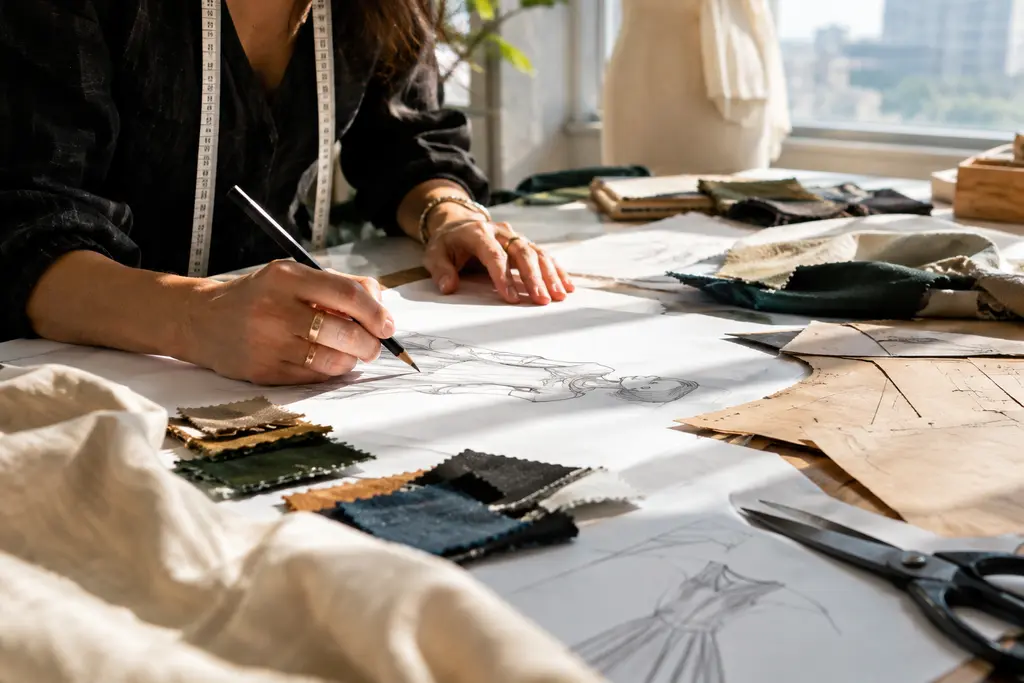
A fashion listing should be drafted like a pattern. The silhouette comes first: what exactly is being sold? Then the seam allowances: what variations are allowed, what cannot be changed, and what production time is realistic? Then the fitting notes: which measurements does the buyer provide, and what happens if the buyer submits incomplete information? These are not glamorous details, but they keep a seller from turning art into customer-service smoke.
The strongest creator commerce strategies often reduce choice rather than multiply it. A designer might offer three fabric options, two lengths, and one clearly priced customization path rather than twenty vague possibilities. Too much choice can make a handmade shop feel uncertain. A controlled menu can feel like couture discipline adapted to a small studio.
- Lead with construction: show seams, lining, closures, beadwork, or hand-finishing where it affects value.
- Separate inspiration from ownership: describe mood, period, or technique without implying licensed use of protected characters or celebrity likenesses.
- Use plain fit language: include garment measurements, body-measurement guidance, and tolerance ranges if custom sizing is offered.
- Control production promises: state processing time in concrete terms, especially for wedding, festival, or gift orders.
- Archive your proof: keep sketches, supplier invoices, process images, and customer approvals for internal records.
Mobile Discovery And The Small-Screen Test
The provided research notes report that Etsy’s mobile app generated about 47% of total GMS in Q2 2026, with modest year-over-year share growth and roughly flat sequential movement. Since this detail comes from supplied research rather than one of the cited source links here, it should be treated as a reported company-data point, not as an independent market forecast. For sellers, the practical lesson is still modest and useful: a listing has to read clearly on a phone.
Fashion designers should test their first image at thumbnail size. A full-length gown photographed in a crowded room may look like a dark matchstick on a small screen. A cropped image showing neckline, textile, and silhouette may earn more serious inspection, provided the gallery also shows the complete garment. Product titles should not perform poetry alone. They should carry material, category, and use case without stuffing repeated words into a stiff little parade.
Trust, Rights, And Handmade Fashion Claims
The Integrity Of Influence
Fashion has always borrowed from paintings, stage costume, folk dress, architecture, grief, weather, cinema, and the old private theater of memory. Influence is not the problem. Confusion is. A seller can say a cape is gothic, ceremonial, botanical, medieval-inspired, or surreal in mood if those words are accurate. A seller should be careful about using names, protected characters, celebrity likenesses, or direct visual copying as a commercial shortcut. This is not legal advice; it is a cautious product-review standard for preserving buyer trust and artistic respect.
The same principle applies to AI-aided design language. If tools shape mood boards, thumbnails, or copy, the seller still needs to verify that the final product photos, material claims, and production statements describe the real garment. Buyers are not purchasing a prompt. They are purchasing cloth, labor, finish, and delivery.
From Social Attention To Repeat Buyers
Creator-led selling often begins with a dramatic post: the dress turning in a studio, the maker’s hands pulling thread, the package tied like a charm. That spectacle can attract the first glance, but repeat buying depends on whether the object matched the promise. Designers interested in adjacent commerce analysis can compare related seller-channel questions through creator commerce for fashion, while broader network readers may also find context at Robsonic, a related site in the same network.
For fashion sellers, customer retention is not merely a marketing metric. It is a fit issue. If a buyer returns, the first garment likely survived the distance between image and body. That distance is where many creator shops fail: colors shift, measurements were unclear, delivery windows were hopeful, or the theatrical promise outgrew the physical product.
Creator Commerce Strategies Amid Etsy Initiatives
The most durable creator commerce strategies after Etsy’s brand push are not loud. They are exact. A designer should decide which role the shop can honestly occupy: custom atelier, giftable accessory studio, vintage editor, occasionwear maker, or small-batch art-fashion label. Each role demands different photography, inventory control, pricing, and response time.
Etsy’s scale gives independent designers exposure to a large buyer base, and its recent brand initiatives appear to favor the image of the human maker. Yet the evidence does not support careless optimism. The marketplace is crowded, custom work carries operational strain, and brand campaigns cannot repair weak product pages. Treat every listing like a garment under a bright fitting-room bulb: no myth should hide a crooked seam, and no metric should replace the disciplined beauty of a clear promise kept.