
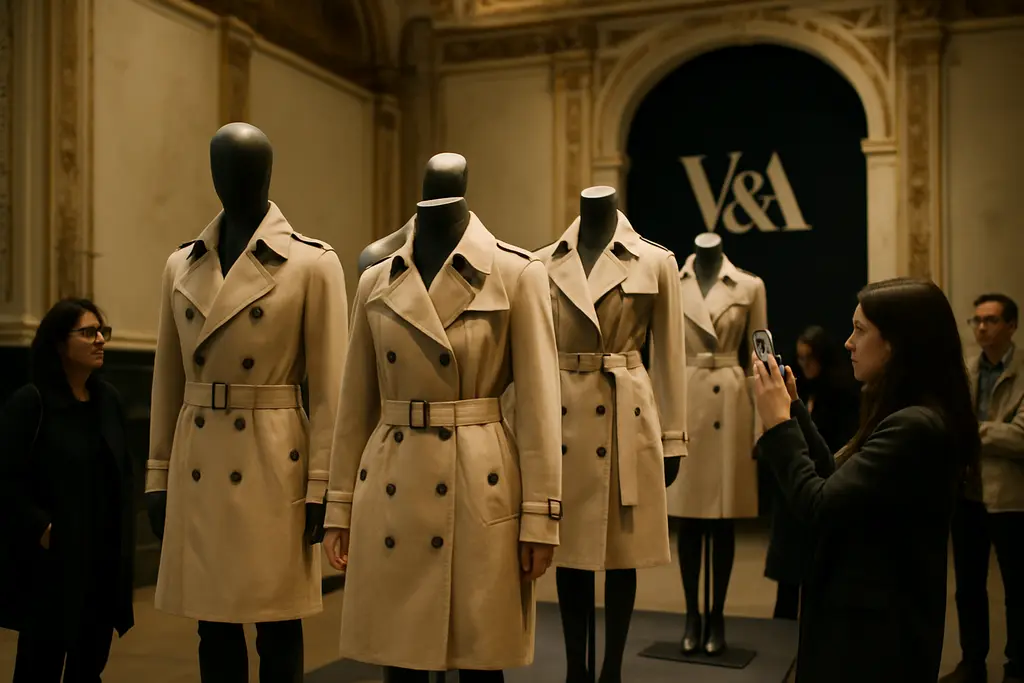
Burberry Trench Evolution now sits at a useful point for fashion students, costume makers, and small-label designers: close enough to retail desire to feel familiar, yet old enough to require careful study rather than casual imitation. As of September 10, 2026, the next major public marker is still ahead: The Burberry Trench: Crafting an Icon, a free display scheduled at the Victoria & Albert Museum in South Kensington from September 21, 2026, to January 3, 2027. The display matters because it frames the coat not as a single object frozen in rainwater and myth, but as a pattern system: cloth, collar, flap, belt, check lining, military memory, runway revision, and brand authorship held together under pressure.
Burberry Trench Evolution At The V&A
Display Dates And Institutional Framing
The V&A display is scheduled for the Prince Consort Gallery and marks Burberry’s 170th anniversary, according to the Burberry and V&A announcement. The display is described as tracing the trench coat from military and practical outerwear toward its status as a globally recognized symbol of British fashion. That institutional framing deserves a cool eye. A museum setting can slow the viewer down, but this is also a brand-linked presentation, so the evidence on view will need to be read as both fashion history and brand narrative.
The strongest factual anchor is material. The display begins with Thomas Burberry’s 1879 invention of cotton gabardine, identified in the announcement as weather-resistant and central to the trench coat’s functional roots. For makers, that point should not be treated as a romantic footnote. A trench begins with fabric behavior. Cloth either sheds, bends, creases, holds a belt, and accepts topstitching, or it does not. The garment’s aura rests on engineering before it reaches advertising, cinema, or celebrity.
Burberry Trench Evolution As Pattern Evidence
Burberry Trench Evolution is especially visible in the parts most casual viewers skip: the hand-finished collar, House Check lining, storm flap, detachable throat latch, epaulettes, and belt. These details are listed by the V&A display announcement as signature elements still used today. A designer should read them as a chain of decisions, not decoration scattered across beige cloth. The storm flap answers weather. The throat latch answers wind. Epaulettes carry military association. The belt controls volume. The lining marks brand identity at the garment’s interior, where private construction becomes public memory when the coat opens.
The display’s “Creativity” section is expected to include 19 runway looks from the past 25 years by Christopher Bailey and Daniel Lee. That number is small enough to encourage close comparison. The question is not whether each look is beautiful. The better question is which features remain legible after proportion, surface, color, or styling shifts. If a trench loses its storm logic, collar authority, and belted architecture, it may still be a coat, but its claim to trench ancestry grows weaker.
Utility, Archive, And Runway Reinterpretation
The FIT Afterimage
The New York counterpart has already passed. The Museum at FIT held Beyond Utility from February 25 to March 22, 2026, presenting utility garments, including Burberry’s trench, beside work associated with designers such as Bonnie Cashin, Issey Miyake, and Junya Watanabe, according to the exhibition page for Beyond Utility. Because that exhibition ended before September 10, 2026, it should be discussed retrospectively, as a recent lens rather than an event to attend.
FIT’s utility frame is useful because it loosens the trench from pure brand worship. Utility garments become powerful when their parts keep explaining themselves after style has changed. Pockets, closures, weather barriers, straps, and reinforcement points are not neutral; they teach the body how to move. A trench coat asks the wearer to cinch, fold, button, raise the collar, and carry the coat’s weight across the shoulders. That choreography is why the garment keeps returning to runways without becoming a mere costume relic.
For insights on adjacent cultural topics within the same network, Next Clues serves as a companion site offering additional coverage. However, the claims here rest on the museum and brand materials cited above. That distinction matters. Fashion writing turns smoky very quickly when admiration outruns evidence. The trench deserves poetry, yes, but it also deserves pins, seams, dates, and documented objects.
What The Creator Should Inspect
Aspiring creators should treat these exhibitions like a fitting room for ideas, not a permission slip to copy. The safer and more original lesson is structural: study why a detachable throat latch exists, how a belt changes volume, why a collar needs firmness, and how lining can become an identity system without shouting across the exterior. For related reading on how silhouette can carry argument, our analysis of Spring 2026 structural fashion offers a useful parallel.
- Look first at fabric behavior: weight, drape, water resistance, and edge stability.
- Separate functional details from brand-specific identifiers before sketching.
- Compare runway reinterpretations by retained structure, not only surface styling.
- Respect archive garments as evidence, especially when rare pieces enter public display.
A Cautious Product Review For Makers

Pattern Lessons Without Copying The Coat
Burberry Trench Evolution offers a rare product-review lesson because the “product” is less a seasonal purchase than a working template refined across time. From a maker’s bench, the trench is a demanding teacher. It punishes weak fabric choice. It exposes lazy collar drafting. It makes belt placement obvious. It reveals whether topstitching is confident or merely decorative. The coat has survived not because every version looks identical, but because its core grammar can withstand reinterpretation.
The V&A announcement also notes rare archive material, including early 20th-century catalogues and a Burberry trench worn by designer Hardy Amies, planned for public display for the first time. That is the portion I would approach with the sharpest pencil. Archive catalogues can show how garments were presented, named, and sold. A worn coat can show stress points, proportion, and the difference between a press image and a lived object. Still, until visitors and scholars can examine the display after it opens on September 21, 2026, claims about the full curatorial argument should remain careful.
For small brands, the temptation is to borrow the trench’s authority: beige cloth, belted waist, dramatic collar, rain-soaked romance. That is thin work. The better assignment is to ask what your own garment must do. If it is outerwear, what weather does it answer? If it has a belt, what volume does the belt control? If it uses a lining motif, does that motif belong to your studio language, or is it only a borrowed signal? Ethical design starts with function, then shape, then reference.
What Burberry Trench Evolution Teaches Makers
Burberry Trench Evolution teaches that an enduring garment is rarely born from ornament alone. It needs a reason to exist on the body. The trench began in practical outerwear and military association, but the upcoming V&A display suggests that its lasting force comes from the repeated negotiation between use and image. The coat protects, signals, frames, and performs. It is equipment that learned theatre.
For creators, the responsible takeaway is neither reverence nor rejection. Study the trench as a disciplined pattern problem. Respect the named elements tied to Burberry’s identity. Avoid treating House Check, archive silhouettes, or branded codes as open raw material for commercial mimicry. Instead, build your own design vocabulary from documented needs: weather, storage, movement, closure, repair, and proportion. That is where a garment begins to earn its own shadow under the studio lights.
The upcoming V&A display, paired with the already closed FIT exhibition, gives the trench coat a two-part reading in 2026: one focused on a specific British fashion house and one on utility as a broader design force. Held together, they show why Burberry Trench Evolution remains valuable for serious creators. The lesson is not simply that classics endure. The lesson is that a classic keeps working because its parts still argue clearly for their place.