
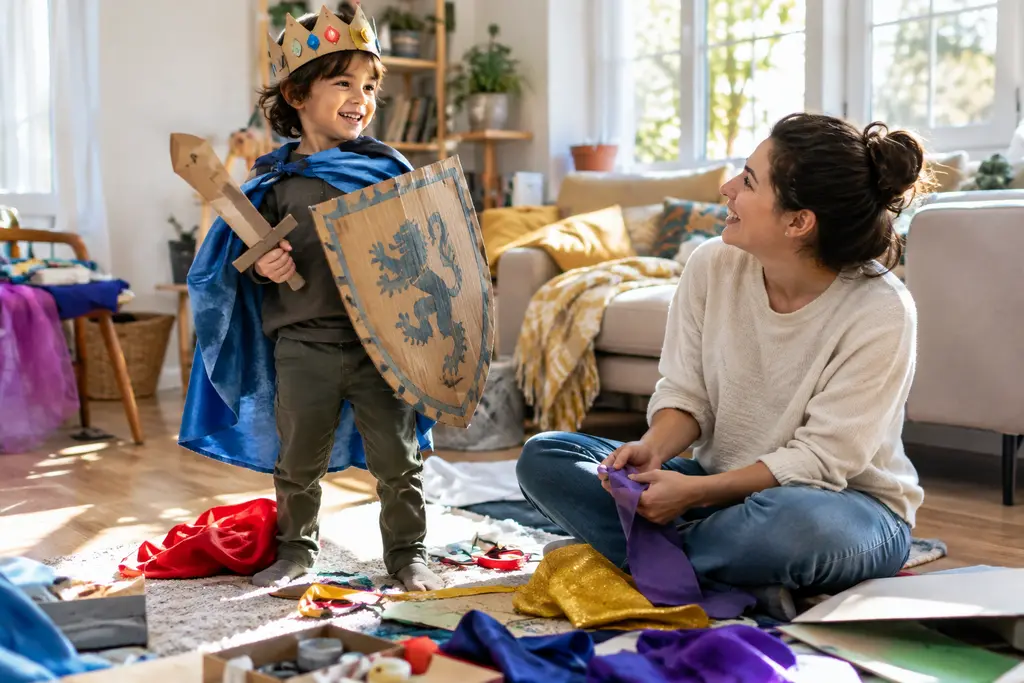
Dress-Up Play Benefits offer a useful lens for reading a “Costume Art” exhibit, provided the exhibit is treated with care rather than used as a template for copying. No verified venue, date, curator statement, or checklist for the named exhibit was supplied, so the discussion here stays with what can be supported: costume themes can prompt pretend play, role language, material exploration, and thoughtful conversations about identity. That does not mean every costume display produces measurable developmental gains on its own. It means an adult can use costume art as a respectful prompt for child-led dress-up activities at home, in classrooms, or during museum-adjacent learning.
Why Costume Art Works As A Play Prompt
Costume Themes Invite Role Thinking
Costume art sits between clothing, theatre, craft, and visual storytelling. A child looking at a cape, mask, apron, crown, or exaggerated sleeve may begin asking practical questions: Who would wear this? What could this person do? How would they move? Those questions are not minor. They are the foundation of role play, where a child tests social positions through gesture, voice, and props.
Research on preschool pretend play supports a cautious reading of that process. A naturalistic observation study of children aged 3 to 5 found that older preschoolers more often used higher-level pretend play behaviors, including role play and metacommunication, and could combine multiple pretend behaviors at once preschool pretend play study. That finding does not prove that a costume exhibition causes advanced play. It does suggest that a costume-themed environment can offer material cues that fit the way many preschool children already build pretend scenarios.
For a related discussion of costume, art settings, and cautious developmental claims, Fairytale Fashion has also examined wearable art and play through a similar evidence-aware frame.
Dress-Up Play Benefits And Costume Art
Dress-Up Play Benefits As A Viewing Frame
Dress-Up Play Benefits are strongest as a frame for interaction, not as a promise attached to any single hat, gown, or theatrical object. The adult’s role is to slow the encounter down. Instead of asking a child to identify the “right” character, the adult might ask what materials seem soft or stiff, what movements the costume permits, and what kind of story the child wants to invent from it.
The evidence base also warns against simple cause-and-effect claims. A longitudinal study using data from the Longitudinal Study of Australian Children reported that higher pretend play ability at ages 2 to 3 was associated with fewer internalizing and externalizing behavior problems at ages 4 to 5 and 6 to 7, even after controlling for attachment and other predictors longitudinal pretend play research. The same research reported that emotional regulation did not significantly mediate the link, which means the pathway may involve other factors as well. For costume-based activities, that finding supports modest language: pretend play may be associated with later adjustment, but a costume activity should not be described as therapy or guaranteed prevention.
From Gallery Object To Safe Home Play
A costume viewed in an exhibition can become a starting point for low-cost, non-replicating play. A child does not need a museum-quality garment to respond to a silhouette. A towel can become a traveling cloak. A cardboard tube can become a telescope. A ribbon can mark a dancer, messenger, gardener, or imagined royal attendant. The best DIY response is not a copy of a displayed artwork; it is a child-safe interpretation of a broad theme such as travel, celebration, disguise, work, ceremony, or weather.
This distinction protects artistic integrity. Original costume designs may carry identifiable authorship, cultural references, or rights concerns. Families and educators can discuss shape, texture, and function without recreating protected characters or presenting a derivative copy as original work. For anyone exploring family-oriented materials through the same network, they can find a related site connection at Kay Granger’s site, ensuring that discussions stick to supported research rather than network ties.
Designing DIY Responses Without Copying
Materials Before Likeness
A respectful costume response begins with materials, not imitation. Ask what the exhibit object seems to do: Does it widen the shoulders? Does it trail behind the body? Does it sparkle under light? Does it restrict or free movement? Children can translate those observations into their own play garments through scarves, paper cuffs, recycled boxes, soft belts, fabric scraps, or safe fasteners.
Dress-Up Play Benefits often arise because the child negotiates meaning. If one child wants a silver sash to signal a moon explorer and another sees it as a river guide, both readings can coexist. The costume is doing developmental work only if it remains open enough for negotiation. A fixed adult script can reduce the child’s chance to plan, revise, cooperate, and speak from a chosen role.
- Use broad prompts such as “traveler,” “maker,” “helper,” “host,” or “creature,” rather than protected character names.
- Choose soft, breathable, low-risk materials and avoid cords around the neck or masks that block sight.
- Invite children to explain their role before correcting details or adding adult-made decoration.
- Credit the exhibition or artist as inspiration when discussing the activity, while keeping the child’s design distinct.
Fairytale Design Without Direct Borrowing
Fairytale costume play works especially well because archetypes can be broad. A “forest messenger” does not need to copy a known princess. A “star baker” does not need to borrow a film design. Capes, crowns, aprons, wings, and boots can function as symbols rather than likenesses. This allows adults to introduce art vocabulary—line, balance, volume, contrast, texture—without asking children to reproduce a specific artwork.
That approach also leaves room for cultural care. If a costume in an exhibit draws from a ceremonial practice, a region, or a community tradition, adult-led play should avoid flattening it into decoration. Children can still discuss pattern, craft, and respect. The safer activity is often to create an imaginary festival, invented guild, or story role that does not claim to represent a real community.
Reading Costume Themes With Children
Questions That Keep Play Open
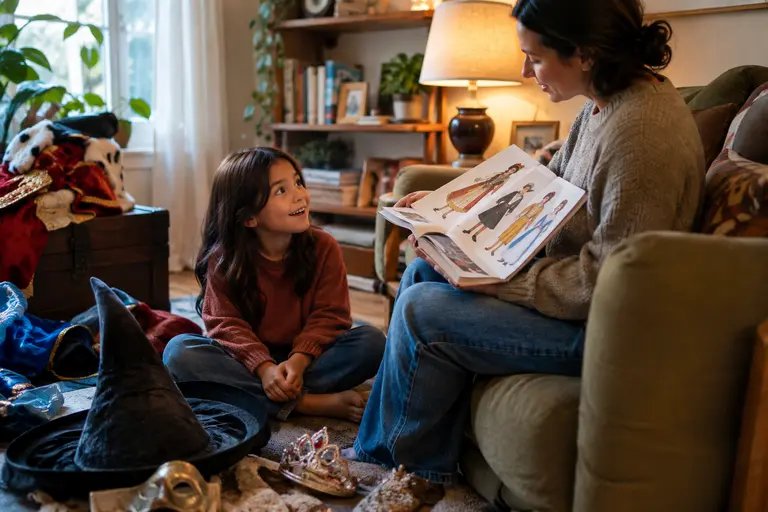
Dress-Up Play Benefits are easier to support when adults ask questions that invite planning and reflection. “What can your character do?” is more useful than “Who are you supposed to be?” “What happens if the cape is too heavy?” can lead to practical reasoning. “How will your group decide who carries the map?” can lead to social negotiation. These questions help connect costume viewing to language, cooperation, and flexible thinking without overstating the research.
Children may also reject an adult’s suggested theme, and that is often productive. A child who turns a royal robe into a blanket for a pretend animal hospital is not misunderstanding costume art. They are showing self-agency by assigning new meaning to material cues. Adults can document that shift through a drawing, a short dictated story, or a photo of the child’s own handmade prop, if privacy rules and family consent allow it.
Evidence, Limits, And Adult Caution
Not every child enjoys dress-up. Some dislike scratchy fabric, face coverings, group performance, or unfamiliar roles. An evidence-based approach makes room for opting out. A child can still engage with costume themes through sketching, sorting fabric, building a small paper puppet, or describing a character without wearing anything. The aim is participation, not performance.
Dress-Up Play Benefits should also be interpreted against age and context. Research supplied for this topic notes that pretend play becomes recognizable around ages 2 to 3 and that quality often peaks around ages 5 to 6, but individual children vary. A toddler may simply carry a scarf, while an older child may negotiate rules for an extended story. Both responses can be valid if the adult keeps the setting safe, flexible, and respectful.
Costume Art Exhibit Themes For Dress-Up Play
Turning Observation Into Original Play
The most defensible use of a “Costume Art” exhibit is not to treat it as a pattern book. It is to let costume themes sharpen observation. Children can notice weight, volume, symmetry, color contrast, and movement, then invent their own role from those cues. In that model, Dress-Up Play Benefits come from the exchange between art viewing and child-led invention: the exhibit supplies visual prompts, while the child supplies story, voice, and action.
For DIY dress-up, I would keep the activity small and repeatable: one fabric base, one symbolic accessory, and one open question. A scarf plus a paper badge can become a weather watcher. A cardboard collar plus soft mitts can become a night gardener. A folded apron plus a ribbon can become a festival cook. These are modest designs, but that modesty is useful. It keeps focus on agency, cooperation, and interpretation rather than adult-perfect craft.
Handled this way, costume art can support careful, evidence-aware play without making claims the research cannot bear. The exhibit remains an artwork-centered experience. The home or classroom activity becomes an original response. That separation respects artists, gives children creative space, and keeps pretend play grounded in what current research can reasonably support.