
The Bauhaus Ballet exhibit arrived in New York like a garment cut from memory: stiff in its geometry, soft in its human residue, and haunted by the small domestic things that make fantasy feel lived-in. Szilveszter Makó’s first public immersive solo exhibition ran from September 8 to September 12, 2026, at 29 West 23rd Street in New York City, with public access reported from September 10 to September 12, according to Vogue Philippines. Since the run has now ended, the fair question is not whether viewers should go, but what the installation clarified about fashion photography after it leaves the frame.
Makó’s project was not just a display of images. It treated the photographic set as a body one could enter. That shift matters for designers, prop makers, stylists, and fantasy-fashion creators because it exposed the skeleton behind a surreal picture: angle, surface, inherited object, pose, and performance. Like a coat turned inside out to reveal the facing, the exhibition asked viewers to inspect the seams of image-making without stripping away its spell.
Bauhaus Ballet Exhibit As Fashion Theatre
Bauhaus Ballet Exhibit And The Body
The Bauhaus Ballet exhibit made its strongest case through bodily arrangement. Makó’s visual language has been reported through geometric framing, theatrical portraiture, and constructed sets. In installation form, those devices became less like background decor and more like pattern pieces pinned around a moving figure. A fashion designer notices that instantly: the wall becomes a sleeve head, the prop becomes a collar, the mirror becomes a dart redirecting the eye.
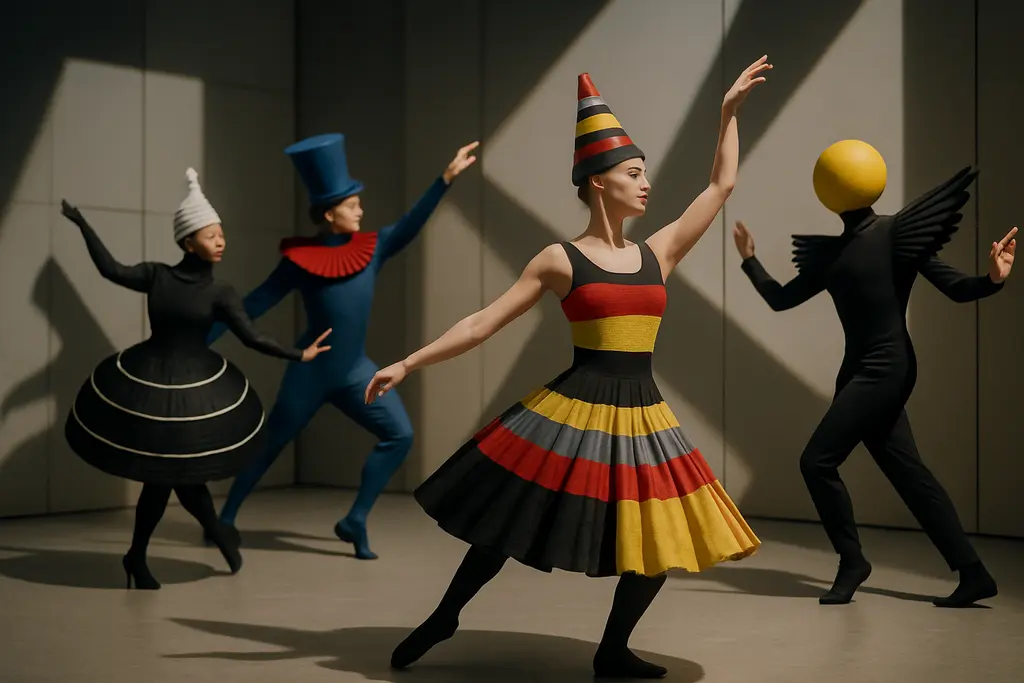
This is where the title’s Bauhaus reference carries both promise and risk. The phrase invites association with Bauhaus theatre, disciplined abstraction, and the famous stage experiments of Oskar Schlemmer’s Triadic Ballet. Yet Makó’s installation, as described in the available reporting, did not appear to be a museum-style lesson in Bauhaus history. It worked more as a personal re-cutting of geometric modernism through post-communist Hungarian memory, folk imagery, and domestic reuse. That distinction preserves artistic integrity. The exhibition’s interest lies not in claiming ownership over a historical movement, but in bending its angular grammar toward private recollection.
Six Rooms, Six Set Logic
The exhibition was presented across six rooms, with Makó’s photographic sets remade as walk-in environments for the first time, as reported by Fashion Times. The six-room structure is useful to consider as a creator’s lesson. A single photograph can hide weak construction through crop and light. A room cannot. Once the viewer steps inside, scale, joint, weight, scent, acoustics, and traffic flow begin to judge the work.
For that reason, the installation’s cultural force rested less on novelty than on translation. Makó translated a controlled camera world into a physical sequence. That move tested whether his fantasy could survive outside the shutter’s narrow mercy. Based on the reported structure, the project treated immersion not as excess, but as proof of concept: if the imagined world has bones, people can walk around inside it.
Material Memory And Eastern European Folklore
Cardboard, Brick, And Domestic Props
The reporting around Makó’s exhibition repeatedly points to childhood in post-communist Hungary, folklore, reuse, memory, and lived material culture. Bare brick walls, inherited cutlery, and repurposed household objects are not neutral set dressing in that context. They function like old linings saved from a family coat: worn, practical, and emotionally charged.
The recurring cardboard house headpiece is especially sharp as a fashion object. It reportedly began as something Makó made as a child for Hungary’s Farsang carnival, and versions have appeared in portraits of major performers including Willem Dafoe, Cate Blanchett, and Gwendoline Christie. From a pattern-maker’s view, cardboard is an honest material. It creases, resists, buckles, and stains. It has none of the false nobility of luxury finish. Placed on the head, it turns shelter into silhouette and childhood craft into ceremonial architecture.
That is the exhibition’s most persuasive aesthetic argument. Fantasy does not need to be polished until it forgets its origin. In Makó’s case, the handmade object seems to retain the pressure of scarcity and invention. The result is not cosplay in the narrow commercial sense, nor couture in the Parisian sense, but a hybrid stage language where poverty of material can become intensity of form.
Sensory Cues Without Spectacle
Reports also noted performance and sensory details: voice, ambient sound, and scent were part of the installation. One described feature included Gwendoline Christie’s voice reading the Hungarian ballad Ágnes asszony, while an exit path used scents of wheat and straw to evoke an Italian summer. Because scent and sound can easily become theatrical padding, the critical question is whether they supported the images or merely decorated them.
On the facts available, the sensory layer appears connected to Makó’s recurring concerns: memory, geography, folk story, and stagecraft. That makes it more defensible than generic immersion. Wheat and straw are not abstract luxury cues; they carry rural and seasonal associations. A ballad reading, if placed with care, can change the room’s tempo. Still, without visitor data, installation recordings, or broader critical reception in the provided research, any claim about audience response should remain cautious.
Creator Lessons From The Installation
Pattern Thinking For Set Builders
For aspiring creators, the practical lesson of the Bauhaus Ballet exhibit is pattern discipline. Makó’s work suggests that a fantasy image becomes stronger when each object answers a structural need. The prop is not simply “weird.” The mirror is not simply “surreal.” The room is not simply “immersive.” Each element appears to redirect the body, the camera, or the viewer’s memory.
A useful studio exercise would be to design backward from one portrait idea. First choose the emotional silhouette: shelter, exile, ceremony, dream, hunger, play. Then assign each material a duty. Cardboard might supply fragility. Brick might supply pressure. Metal cutlery might supply inheritance. Fabric might supply breath. That approach is more respectful than imitating Makó’s specific objects, because it studies function rather than copying surface.
- Use humble materials only when their physical behavior supports the concept.
- Build sets that can be read from several distances, not only through a camera crop.
- Treat sound and scent as narrative materials, not automatic signs of immersion.
- Separate influence from duplication, especially with living artists and recognizable portrait language.
Rights, Likeness, And Respect
The exhibition’s use of newly created portraits of well-known performers, including Gwendoline Christie and Adrien Brody in the research notes, also reminds makers to stay careful with likeness and rights. This is not legal advice, and no broad rule can be drawn from one art presentation. For sellers and independent designers, the safer creative path is to build original characters, original styling systems, and original prop languages rather than relying on celebrity resemblance or recognizable copyrighted figures.
That caution matters because immersive fantasy often tempts creators toward borrowed faces and familiar worlds. Makó’s reported strength lies elsewhere: in the conversion of personal memory into a visual system. For fashion-adjacent readers seeking more related insights, they might explore Kay Granger for a broader editorial perspective while this review remains focused on the exhibition specifics.
Bauhaus Ballet Exhibit And Cultural Impact
The cultural impact of the Bauhaus Ballet exhibit should be described with restraint. The research provided does not include visitor numbers, sales data, museum acquisition news, or a wide survey of critical response after September 12, 2026. What can be said is narrower and more useful: Makó’s New York installation placed fashion photography inside the grammar of immersive art during the New York Fashion Week calendar, and it framed surreal portraiture as an environment rather than a flat image.
That placement has symbolic weight. Fashion week often prizes speed: looks, cameras, names, exits. Makó’s six-room structure asked for slower reading. It treated the fantasy set as cultural memory, not disposable backdrop. For designers, that is the lasting cut of the cloth. The exhibition showed how a personal archive—cardboard carnival forms, household remnants, folk echoes, geometric staging—can become a spatial language without surrendering its private origin.
As a review, then, the Bauhaus Ballet exhibit succeeds most clearly as a study in translation: photograph to room, prop to garment-like structure, childhood object to public symbol. Its broader influence remains uncertain until more reception and later exhibition evidence appear. Yet its immediate value is plain enough. It gave creators a disciplined example of how fantasy can be built from ordinary matter, provided the maker knows exactly where every shadow, angle, and object is meant to stand.