
This Costume Art review treats The Metropolitan Museum of Art exhibition as both a museum presentation and a fashion product: something planned, installed, interpreted, and experienced by visitors. The show opened to the public on May 10, 2026, in the new Condé M. Nast Galleries at The Met Fifth Avenue, and the museum lists January 10, 2027, as its closing date The Met listing. That timing matters because the exhibition was still open as of November 5, 2026, so any assessment has to account for its live public function as well as its critical reception.
Costume Art Review: Display Logic And Value
Costume Art Review Criteria For Visitors
For this Costume Art review, the most useful criteria are clarity, object quality, accessibility of interpretation, and respect for the bodies represented. The exhibition is not a retail product, yet it functions like one in the visitor’s decision-making process. A visitor spends time, attention, and, depending on residency and admission category, money. The show has to justify those costs through organization and interpretive force rather than spectacle alone.
The exhibition’s central claim is that clothing should be read in direct relation to the body. That gives the show a tighter frame than a broad survey of beautiful garments. It asks whether dress can sit beside sculpture, painting, and other art objects without being treated as a decorative afterthought. On that point, the product proposition is unusually strong: visitors are not only seeing garments from The Costume Institute, but seeing them placed against objects from other Met collecting areas.
Dates, Scale, And Placement
The exhibition occupies nearly 12,000 square feet adjacent to the Great Hall, placing fashion near one of the museum’s most visible public routes. The Art Newspaper reported that the show includes roughly 400 objects, combining garments from The Costume Institute with artworks from across The Met’s seventeen other collecting areas and spanning more than 5,000 years of art The Art Newspaper review. Those numbers are not minor supporting details. They explain why the exhibition feels less like a seasonal costume display and more like an institutional argument about fashion’s place inside an encyclopedic museum.
General admission includes the exhibition, according to the museum’s public listing. The Met also listed early access for members on select weekends from 9 to 10 a.m., a published catalogue, and an accompanying symposium scheduled for November 14, 2026, at 11 a.m. at The Met Fifth Avenue. Those features make the exhibition more layered as a public-facing product, especially for visitors who want scholarship, not only visual impact.
Garment Highlights And Body-Based Categories
Standout Pieces In The Product Mix
The strongest product value in this Costume Art review sits in the object range. The research notes identify several pieces that have drawn notice in reviews: Dilara Fındıkoğlu’s 2023 Earthly Paradise dress with synthetic hair motifs, Thom Browne’s skeleton dress sequined in seed beads, a red Yohji Yamamoto silk-crêpe dress shaped into visceral folds, and a Vetements gray hoodie embroidered with I’M RETIRED (This is as dressed up as I get), reported at $780. The range is wide, moving from couture-level bodily metaphor to an anti-formal hoodie that still enters the museum frame.
That mix is productive because it prevents the exhibition from treating costume as only high ceremony. A skeleton dress, a hair-motif dress, a folded red silk-crêpe form, and a slogan hoodie each work through the body in different ways. One invokes anatomy, another surface and growth, another flesh-like compression, and another the refusal of formal dress codes. Not every visitor will read those meanings the same way, but the range gives the show enough friction to keep it from becoming a simple parade of impressive garments.
Body Typologies And Representation
The exhibition is organized around body typologies, including Naked and Nude Body, Abstract Body, Aging Body, Anatomical Body, Pregnant Body, Mortal Body, Epidermal Body, and Reclaimed Body. This structure is one of the show’s defining curatorial choices. It shifts attention away from designer chronology and toward how clothes construct, reveal, restrict, decorate, and sometimes contest the body.
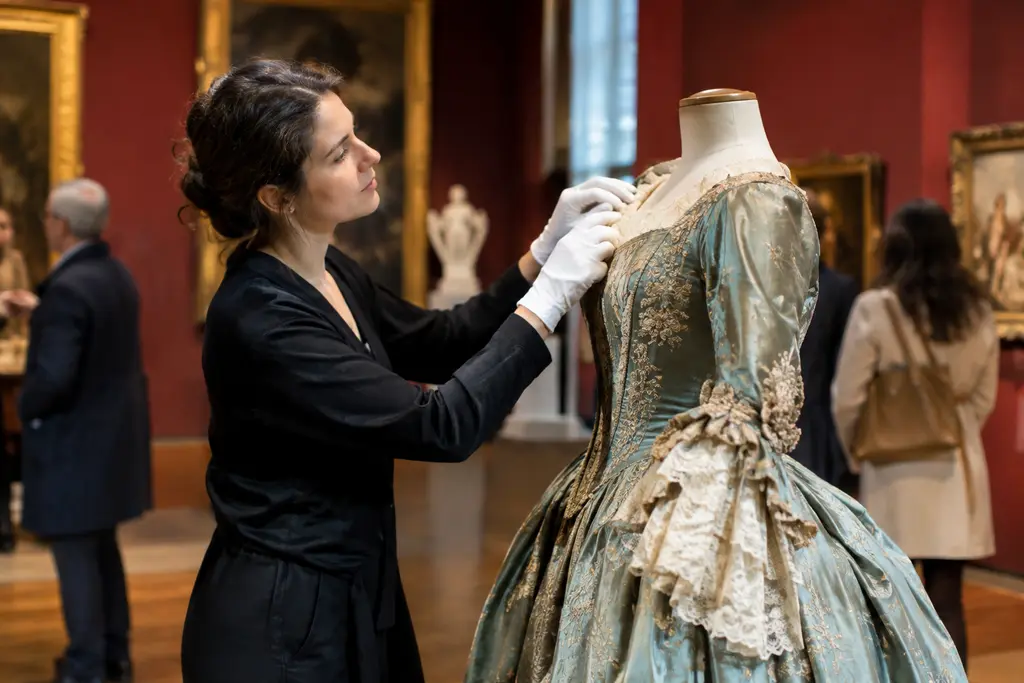
The mannequin strategy is especially significant for fashion display. The research notes describe varied body types, including pregnant bodies, people in wheelchairs, and little people. Many forms were scanned from real people. In fashion exhibitions, that is still a meaningful departure from the narrow, elongated display body that has often dominated museum and retail presentation. The choice does not solve every issue of representation, but it changes what kinds of bodies are allowed to carry fashion history in a major museum space.
- The body categories make the exhibition easier to read as an argument rather than as a designer-by-designer survey.
- The varied mannequins help connect garment structure to lived physical form.
- The mix of couture, ready-made, and conceptual pieces broadens the definition of costume without erasing craft.
Gallery Architecture And Art Pairings
Permanent Feel, Rotating Fashion
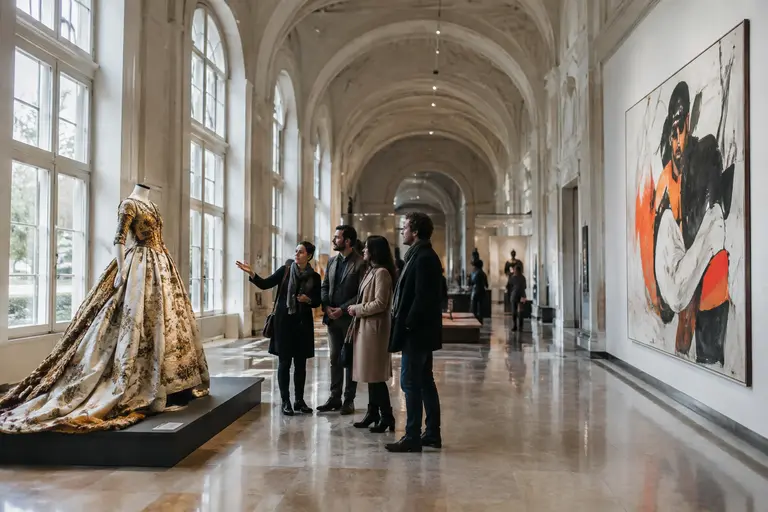
The new galleries were designed by Peterson Rich Office, according to the research notes, with plaster walls that echo classical museum galleries. The space includes a High Gallery with 21-foot ceilings, a Low Gallery, an Orientation Gallery, and a Finale Gallery. The architecture was intended to feel permanent, while fashion items will rotate because of light sensitivity. This is a key distinction. The museum has built a lasting platform, but the objects most vulnerable to environmental damage cannot remain on view indefinitely.
From a product-review standpoint, that design strategy is persuasive. Temporary exhibitions often feel like inserted stage sets. Here, the galleries appear to signal institutional commitment. Fashion is not being placed in a marginal room or treated as event décor. It is being housed in a purpose-built area that supports comparison with older art categories. For readers comparing exhibition-led style coverage across the same publishing network, related culture coverage at kaygranger.com offers a useful adjacent reference point.
Where The Pairings Work, And Where They Strain
A cautious Costume Art review has to address the pairings, because this is where the exhibition’s ambition is most visible and most exposed. The curatorial aim attributed to Andrew Bolton is to reveal the inherent relationship between clothing and the body, asking viewers to look at art through the lens of fashion. One noted pairing places Van Gogh’s Irises from 1890 near haute couture looks by Yves Saint Laurent from 1988 and Loewe from 2025. That kind of comparison can be illuminating when it helps viewers see color, surface, and bodily framing across media.
Some critical reservations in the research notes deserve attention. Certain pairings were described by critics as superficial or strained. One example involved a disabled designer’s ensemble shown with an ancient votive ear, which raised questions about interpretive sensitivity. Other concerns focused on sections such as Pregnant Body and Reclaimed Body, where the inclusion of works by cis men was seen by some critics as weakening thematic precision. These critiques do not negate the exhibition’s value, but they show the risk of using bodies as categories. If a category is too broad, the lived stakes can become blurred.
That caution is relevant to DIY dress-up culture as well. Exhibition influence should not become a prompt to copy the identity markers, bodily references, or personal experiences of others as costume decoration. The better lesson is structural: study how silhouette, surface, placement, and material can communicate ideas without reducing people to motifs. Our related analysis of costume design trends follows the same concern with body diversity, sculptural tailoring, and the dialogue between fashion and art.
Product Reviews: Costume Art Exhibition Highlights
Practical Lessons For DIY Dress-Up
For DIY readers, this Costume Art review points to several useful but cautious takeaways. First, the exhibition shows that body-aware design is not only about fit. It is about how garments describe anatomy, age, movement, exposure, concealment, and social role. A handmade costume or dress-up piece can use proportion, volume, beadwork, quilting, fringe, or controlled folds to suggest an idea without imitating a specific designer’s protected work or a person’s identity.
Second, the show supports a slower approach to inspiration. The most useful influence is not a one-to-one copy of a Thom Browne skeleton dress, a Yohji Yamamoto fold, or a Fındıkoğlu hair motif. A more respectful approach asks what the object is doing. Is it using texture to suggest skin? Is it using structure to change posture? Is it using a plain garment, such as a hoodie, to question the line between dressing up and opting out? Those questions are safer and more productive for makers than surface imitation.
Third, the exhibition makes a strong case for display quality. In a museum, lighting, wall texture, mannequin shape, and object spacing guide interpretation. In creator commerce or cosplay presentation, the equivalent might be a neutral background, clear scale references, honest material notes, and photography that shows how a garment sits on the body. Those choices do not need museum budgets. They require discipline and an awareness that presentation can change how a garment is understood.
The exhibition’s best highlights are not only individual pieces, although several are memorable. Its deeper value lies in the way it asks visitors to see clothing as an argument about bodies. That argument is not flawless, and some pairings appear to have drawn reasonable concern. Still, as a fashion exhibition product, Costume Art offers a serious, ambitious model for how dress can be evaluated beside painting, sculpture, and historical objects without losing its physical intimacy.