
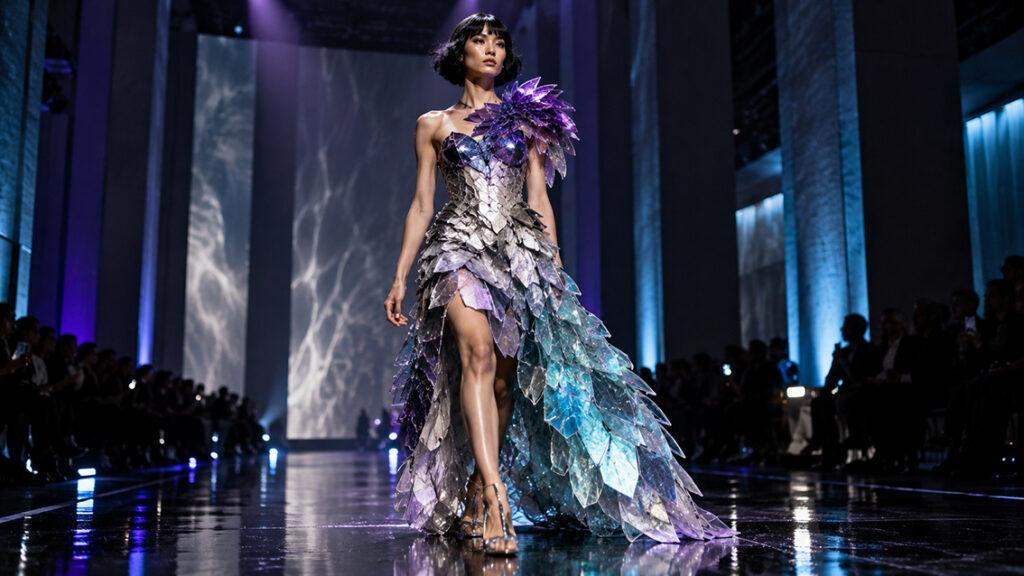
Fashion has spent decades borrowing visual ideas from science fiction, from metallic fabrics and futuristic silhouettes to illuminated accessories and cyberpunk-inspired clothing. At Paris Fashion Week on September 29, 2026, Japanese designer Kunihiko Morinaga pushed that relationship further with Anrealage’s Spring/Summer 2027 collection, SKIN.
Anrealage’s color-changing dresses reflect a growing interest in technology-driven fashion, where digital innovation reshapes how people express their identities. This intersection of fashion, entertainment, and online culture extends beyond the runway, reaching audiences who also explore digital sports platforms and resources such as EveryGame sportsbook indpendantly reviewed. Although sports entertainment and programmable clothing serve different purposes, both illustrate how digital experiences continue to influence consumer interests and contemporary lifestyle trends.
The presentation featured six electronically responsive dresses capable of changing their visible colors and patterns. Each incorporated approximately 1,000 to 2,000 electronic-paper elements developed through a collaboration with Massachusetts-based technology company E Ink. Other garments used 3D-printed scales that changed appearance as the viewing angle shifted.
The result was more than a theatrical runway effect. It demonstrated two different ways clothing can become visually dynamic: through physical material properties and through electronically controlled surfaces.
According to E Ink’s September 30 announcement, the collaboration integrated E Ink Prism 3 technology into six dresses, creating surfaces that could display multiple appearances without replacing the garments themselves. eink.com
For designers working in fantasy fashion, experimental textiles, and wearable technology, Anrealage raises an important question: are programmable garments finally moving beyond runway spectacle toward practical cyberwear?
Anrealage’s Spring 2027 SKIN Collection Turns Clothing Into a Changing Surface
Morinaga presented SKIN at the Maison de la Radio et de la Musique in Paris, marking Anrealage’s 25th presentation at Paris Fashion Week.
Rather than treating clothing as a fixed object, the designer approached garments as adaptable outer layers. The concept drew connections between biological skin, which can change in appearance, and digital avatars, whose visual identities can be altered almost instantly.
The collection developed this idea gradually. Early looks featured fitted bodysuits, layered textures, scale-like embellishments, and visual references to digital characters. Traditional Japanese materials appeared alongside technical textiles, creating a contrast between handcrafted surfaces and engineered effects.
As the presentation progressed, the garments became increasingly architectural. Scale structures created sculptural forms, while color-changing materials introduced the impression that the clothes were transforming as the models moved.
The official Spring/Summer 2027 collection presentation described a progression from second-skin silhouettes to engineered, armor-like eveningwear. The runway ultimately connected physical clothing with the changing appearances familiar from video games and digital environments. Fashion Week Online®
This approach has particular relevance to fantasy fashion. Traditional costume design frequently uses interchangeable armor, layered fabrics, decorative scales, and elaborate accessories to communicate transformation. Anrealage explored how similar effects might be built directly into the material structure of a garment.
The distinction matters because futuristic clothing does not necessarily require a screen or a visible electronic device. Sometimes, a textile that responds to light, movement, or perspective can create an equally convincing sense of transformation.
How E Ink Makes Anrealage’s Dresses Change Color
The most technically significant pieces in SKIN were six cocktail and evening dresses incorporating E Ink Prism 3 technology.
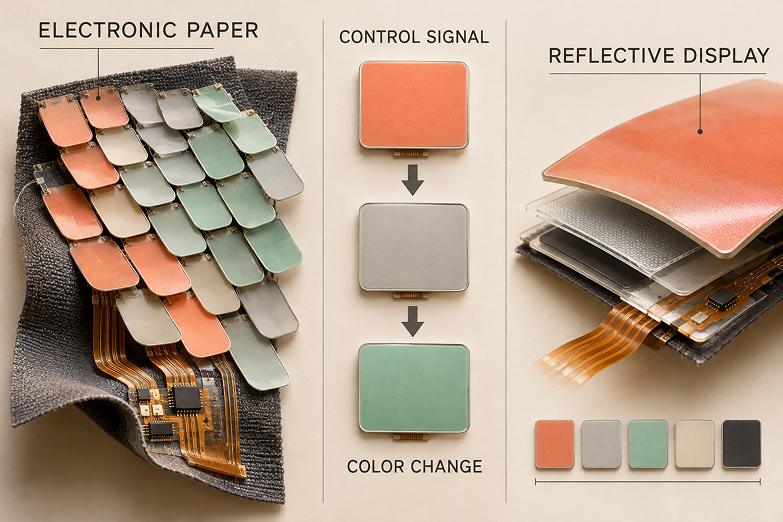
Unlike conventional illuminated costumes, these garments did not depend on hundreds of LEDs shining outward. Their electronic-paper components changed their visible appearance while reflecting ambient light.
E Ink technology is already familiar through electronic reading devices, but its use in architectural surfaces, accessories, and experimental fashion introduces different design possibilities.
The company describes its Prism technology as a programmable material for surfaces that can display changing colors and patterns. A key characteristic is bistability: a displayed state can remain visible without continuous electrical power, although changing the state requires energy.
This makes electronic paper fundamentally different from conventional illuminated displays.
| Technology | How the Visual Effect Works | Fashion Application |
|---|---|---|
| E Ink electronic paper | Electronically changes a reflective surface’s appearance | Programmable garment patterns |
| 3D-printed optical scales | Changes perceived color with viewing angle | Sculptural, movement-responsive clothing |
| LED textiles | Produces visible light electronically | Illuminated costumes and performance wear |
| Photochromic materials | Responds to specific light exposure | Light-reactive clothing |
The table describes general technology categories rather than claiming that every material was used in Anrealage’s electronic dresses.
Each of the six E Ink garments incorporated roughly 1,000–2,000 individual electronic-paper pieces. These were arranged in overlapping, scale-like formations, giving the dresses a protective, almost armored appearance.
The visual transformation was coordinated through circuitry beneath the garment’s exterior. Patterns could move across the surface, disappear into neutral tones, and reappear in different configurations.
This construction represents a substantial design challenge. A conventional printed textile receives its pattern during manufacturing. An electronically programmable garment must incorporate the materials and electrical systems needed to modify that pattern after construction.
It also needs to accommodate the human body, which bends, twists, sits, walks, and changes shape continuously.
Anrealage’s achievement was not simply putting electronic components onto clothing. It was incorporating those components into a recognizable fashion silhouette while maintaining a coordinated visual effect.
Why 3D-Printed Scales Matter for the Future of Fashion
Although the collection is often described as featuring 3D-printed color-changing dresses, an important technical distinction deserves attention.
The 3D-printed optical scales and the electronically controlled E Ink scales were separate material approaches within the broader collection. They should not be treated as identical technologies.
Anrealage used SEKISAI’s Effective Skin technology to create 3D-printed elements that shifted their perceived colors according to the viewer’s position. This produced an optical effect associated with movement, geometry, and changing light.
These structures did not require the same kind of electronic programming used by the E Ink garments.
Instead, their visual behavior depended on the physical design of the material.
The technical coverage of Anrealage’s 3D-printed scales explains how the collection combined angle-responsive printed structures with electronically controlled eveningwear. designboom.com
For independent designers, this difference could be especially important.
Electronic clothing introduces requirements involving power supplies, wiring, controllers, and component protection. Passive optical structures may offer some dynamic visual effects without those additional systems.
3D printing also allows designers to experiment with forms that would be difficult to construct using conventional woven fabric alone. Individual scales can be designed with particular thicknesses, angles, surface patterns, and attachment methods.
That opens opportunities for fantasy costumes inspired by dragon armor, insect shells, mythical creatures, and futuristic protective clothing.
However, the practical results depend on the material selected. A rigid printed scale may work effectively as a decorative surface while remaining unsuitable for areas requiring significant flexibility. Weight, sharp edges, attachment strength, and skin contact also need consideration.
The most promising direction may therefore involve combining conventional textiles with selectively placed 3D-printed structures rather than replacing every fabric component with printed plastic.
Is Programmable Cyberwear Finally Becoming Practical?
The term cyberwear often describes fashion influenced by cyberpunk aesthetics: technical fabrics, dark color palettes, modular accessories, reflective materials, and electronic components.
Anrealage’s collection suggests a more functional interpretation. Instead of merely looking futuristic, clothing can contain technology that changes how it appears.
That difference creates several potential applications beyond the runway.
Performance costumes could change their colors between scenes without requiring performers to change outfits. Interactive fashion installations could coordinate visual patterns across multiple garments. Experimental accessories might allow wearers to choose different surface designs through electronic controls.
In principle, similar technology could support customizable outerwear, handbags, or decorative panels.
However, there is a significant difference between demonstrating a concept at Paris Fashion Week and producing a garment suitable for repeated everyday use.
Several engineering questions remain unresolved for mass-market adoption:
- Comfort and durability: Electronic scales, wiring, and controllers must withstand body movement, friction, and repeated handling.
- Power and maintenance: Even low-power electronic-paper systems require energy for changes, while connectors and electronic components need protection.
- Care and repair: Washing, storage, component replacement, and long-term reliability present challenges that ordinary textiles do not face to the same degree.
These considerations do not diminish the achievement of the collection. They establish the difference between a functioning prototype and a commercially practical product.
A dress that changes color during a carefully controlled runway presentation proves that the visual technology can be integrated into clothing. It does not establish that the same construction can survive hundreds of wear cycles or standard garment-cleaning processes.
For cyberwear to become mainstream, the supporting technology will need to become less intrusive, more repairable, and easier to manufacture.
Artificial Intelligence and the Engineering Behind Electronic Clothing
Artificial intelligence also played a role in the technical development of SKIN.
According to the collection’s published description, AI-assisted mapping helped organize the circuitry connecting the electronic-paper scales.
This is a more specific application than the broad claim that artificial intelligence designed the dresses.
The physical arrangement of thousands of individual electronic elements creates a complicated network. Each component must be positioned and connected in a way that supports the intended visual behavior.
Digital planning tools can help designers manage these relationships, particularly when the surface is irregular or must conform to a three-dimensional shape.
The Spring/Summer 2027 collection analysis from DSCENE describes how the electronic scales were connected through dense wiring networks and how AI was used to map their circuitry. designscene.net
This illustrates a potentially important direction for computational fashion design.
Traditional patternmaking concentrates on fit, construction, fabric behavior, and appearance. Programmable clothing adds another layer of complexity: designers must also consider electronics, software, and the relationship between physical movement and digital control.
The process becomes a collaboration between fashion designers, textile specialists, electrical engineers, and computational designers.
For smaller fashion studios, that complexity remains a barrier. Yet it also creates opportunities for modular approaches in which electronics are developed as reusable components rather than custom-built into every garment.
A detachable programmable panel, for example, could be more practical to maintain than an entire dress permanently covered with electronic modules.
That is a possible development pathway, not a product announced by Anrealage.
Sustainability: Can Color-Changing Fashion Reduce Clothing Waste?
One appealing possibility associated with programmable garments is that a single piece could display multiple appearances.
If a dress can change its visible colors or patterns, a wearer might have less need to purchase several visually different versions of the same design.
E Ink has presented this versatility as one potential sustainability benefit of its technology.
However, the environmental argument requires careful examination.
Electronic-paper garments introduce additional materials, including electronic components, wiring, controllers, and potentially batteries. Their production, repair, and eventual disposal can create impacts that do not exist in a conventional fabric dress.
The environmental outcome would depend on how long the garment remains usable, how frequently it replaces other purchases, and whether its electronic components can be repaired or recovered.
Anrealage’s collection also explored textile-printing technology with a more direct manufacturing connection.
Kyocera confirmed on October 2, 2026, that fabrics produced using its FOREARTH inkjet textile-printing system appeared in 27 looks from the Spring/Summer 2027 collection. The collaboration was the sixth between Kyocera and Anrealage.
Kyocera promotes FOREARTH as a system designed to reduce water consumption associated with textile printing. The company’s official announcement about its Anrealage collaboration identifies the technology’s use in the collection. kyoceradocumentsolutions.eu
The presence of both digitally printed fabrics and electronically responsive surfaces is significant. It shows that advanced fashion manufacturing is developing along several paths rather than converging on a single technological solution.
Some innovations focus on production methods. Others change the physical properties of materials. Still others introduce electronic functionality after the garment has been manufactured.
Their environmental effects must be evaluated individually.
What Anrealage Means for Fantasy Fashion and Wearable Art
For fantasy fashion designers, the most compelling element of SKIN may be its interpretation of clothing as an identity that can transform.
Fantasy costumes have long communicated transformation through changing silhouettes, removable layers, symbolic colors, and elaborate materials. Characters acquire armor, magical objects, or new garments to indicate changes in power or status.
Anrealage explored a related concept using technology rather than narrative costume changes.
The collection’s visual language included scales, layered surfaces, digital-character references, and protective shapes. These details created connections between organic creatures and digitally constructed identities.
The presentation also drew inspiration from the phoenix, a mythological symbol of renewal. Its finale incorporated an illuminated garment accompanied by a live performance of the 1919 version of Igor Stravinsky’s The Firebird.
That theatrical ending placed the technological garments within a larger narrative about transformation and rebirth.
For independent creators, the collection offers several useful design principles without requiring access to expensive electronic-paper systems.
Layered surfaces can suggest movement through changes in viewing angle. Contrasting materials can create the impression of transformation. Repeated geometric elements can make clothing resemble scales, feathers, or engineered armor.
Digital fabrication can help produce some of those elements with greater consistency, while traditional sewing and textile construction remain essential for comfort and fit.
The lesson is not that every fantasy costume needs electronics. It is that designers can create more expressive clothing by thinking about how a garment behaves over time, rather than considering only its appearance in a still photograph.
Could Color-Changing Clothing Become an Everyday Fashion Product?
Anrealage’s September 2026 presentation demonstrated that programmable surfaces can be incorporated into sophisticated runway garments. Whether they become common consumer products will depend on improvements beyond visual design.
Manufacturing cost is one major consideration. Thousands of individual electronic components require assembly, connection, and testing. Even if component prices decline, integrating them into flexible garments presents additional production challenges.
Another consideration is consumer demand.
A programmable dress might appeal to performers, fashion collectors, experimental designers, and technology enthusiasts. Everyday customers may prioritize comfort, cleaning convenience, durability, and price over the ability to change patterns electronically.
The earliest commercially practical applications may therefore emerge in smaller accessories or specialized garments rather than fully programmable wardrobes.
Handbags, decorative panels, stage costumes, and limited-edition fashion pieces offer potential environments where visual novelty can justify greater complexity.
Anrealage also has an established history of experimenting with technologically responsive clothing. Previous presentations have explored ultraviolet-reactive materials, transparency effects, and illuminated garments.
In his September 29 runway review for Vogue, Luke Leitch placed SKIN within that longer history of material experimentation.
That continuity is important. The collection was not an isolated experiment by a brand suddenly adopting electronics. It represented another stage in Morinaga’s sustained investigation of how fashion can respond to external conditions.
The progression from optical effects to electronically controlled surfaces suggests that experimental fashion is becoming increasingly capable of combining physical and digital design.
The Next Chapter of Programmable Fashion
Anrealage’s Spring/Summer 2027 SKIN collection does not prove that color-changing clothing is ready to replace conventional textiles.
It does demonstrate that electronically controlled patterns, 3D-printed optical structures, and traditional garment construction can coexist within a coherent fashion collection.
The distinction between these technologies is essential. A 3D-printed scale that appears different from another angle is not the same as an electronic-paper element receiving instructions to change color. Both can produce transformative clothing, but their manufacturing requirements and practical limitations differ.
For the wider fashion industry, the most meaningful development may be the gradual shift from treating technology as an accessory to treating it as part of the garment’s material identity.
That shift could eventually influence costume design, performance fashion, luxury accessories, and interactive clothing.
For fantasy-fashion creators, Anrealage offers an immediate source of inspiration: garments can communicate transformation through their surfaces, structures, and interactions with the surrounding environment.
Programmable cyberwear is already real as an experimental fashion technology. The next challenge is making it comfortable, durable, maintainable, and accessible enough to move from extraordinary runway moments into everyday wardrobes.