
Paul R. Williams Fashion is not a runway label, and that distinction matters. The phrase is best read as a design lens: a way for fashion makers to study proportion, access, elegance, and civic presence through the work of a major Los Angeles architect. Williams’s buildings are not garments, and creators should resist reducing his architectural legacy to surface decoration. Yet the current Los Angeles exhibition focus gives designers, pattern cutters, costume builders, and handmade sellers a rare chance to examine how architectural thinking can discipline clothing: where a seam falls, how a shoulder line frames the body, how function can carry grace without theatrical excess.
Why Paul R. Williams Fashion Reads Architecturally
Paul R. Williams Fashion As Pattern Logic
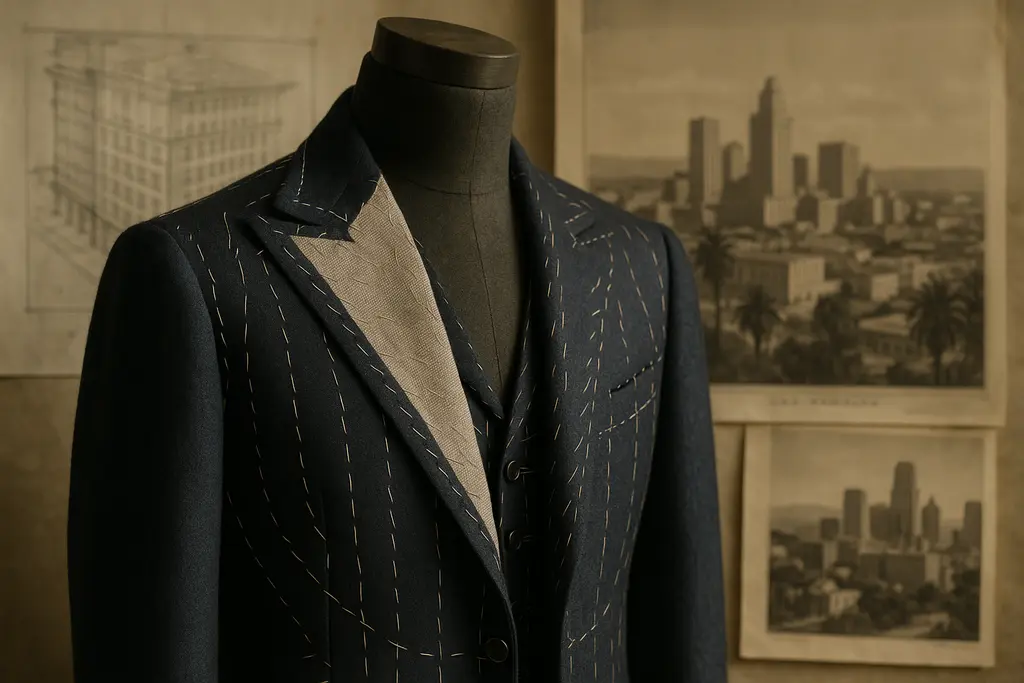
The strongest fashion lesson in Williams’s legacy is not a motif to print on fabric. It is a habit of structure. A garment, like a building, must receive the body before it can flatter it. A jacket with a soft roll through the lapel, a gown with a controlled entrance of volume, or a coat that opens cleanly at the front all depend on decisions that resemble architectural planning. The line is drawn first, then tested against use.
For makers, Paul R. Williams Fashion suggests a shift away from mood-board borrowing and toward construction thinking. The relevant question is not, “How do I make a dress look like a house?” It is sharper: “How does this garment welcome movement, protect dignity, and present the wearer with composure?” That question fits the available research on Williams because the exhibitions frame him through architecture, public life, and access, not through costume history.
Elegance Without Costume Extraction
A cautious fashion reading must protect the integrity of the original work. Williams’s architecture should not be treated as a clip file of arches, façades, or glamorous Los Angeles associations. The better creative response is to study balance: broad planes against fine lines, open thresholds against private interiors, and polish against everyday function. In fashion terms, that may mean a coat whose collar opens like an entryway, a skirt cut with controlled volume rather than spectacle, or a sleeve head that gives the arm authority without stiffness.
This is where product review standards become useful for aspiring creators. A Williams-informed garment should pass three tests. First, the silhouette needs internal reason; volume should support stance, not merely fill space. Second, the materials must suit the garment’s purpose, since elegance collapses when fabric fights the body. Third, the finish should serve the wearer rather than the maker’s ego. A clean facing, a stable hem, and a pocket placed for use are not minor details. They are the garment’s architecture.
Los Angeles Exhibition Evidence
USC Fisher Museum Focus
The USC Fisher Museum of Art exhibition, “Paul R. Williams: An Architect Considered,” is scheduled to run from August 18, 2026, to March 13, 2027, and focuses on Williams’s contributions to modern multifamily housing, with newly commissioned works by contemporary artists and architects included in the presentation USC exhibition report. For fashion makers, that focus is significant because multifamily housing turns the conversation toward shared life, not isolated glamour.
A designer looking at this exhibition might consider how clothing behaves in shared environments: corridors, public transit, markets, studios, ceremonies, and live events. A floor-length hem may photograph beautifully, but it fails if it traps the wearer. A dramatic shoulder may command attention, but it fails if it prevents embrace or work. The USC framing invites a clothing practice that weighs beauty against daily use. That is a hard standard, and a good one.
Getty Research Institute Context
The Getty Research Institute’s “Paul R. Williams: Architecture Across the Color Line” examines Williams’s work in relation to racialized exclusion and architecture Getty exhibition page. The research notes also identify a broader Los Angeles collaboration involving the Getty, LACMA, and USC Fisher Museum of Art from August 2026 through July 2027. That coordination places Williams not as a nostalgic figure but as a designer whose work remains relevant to public arguments about race, equity, and the built environment.
A careful Paul R. Williams Fashion response should not flatten that history into “Old Hollywood” polish. The fashion industry often loves surface glamour while skipping the social conditions that shaped design careers. Williams’s recognition, including the research note that he became the first Black architect licensed west of the Mississippi in 1923 and posthumously received the AIA Gold Medal in 2017, gives creators a more serious frame. The lesson is not only aesthetic. It is professional: who gets commissioned, who gets credited, who is allowed to define taste, and whose labor becomes visible.
Design Lessons For Contemporary Makers
Proportion, Threshold, And Movement
The most useful fashion translation begins with proportion. Williams’s architectural reputation, as presented in the exhibition material, centers on residential, civic, commercial, and housing work rather than a single signature object. That range matters. Contemporary creators can learn from range without claiming direct lineage. A dress can borrow the principle of threshold by making the neckline feel like an entrance rather than an opening cut at random. A coat can use vertical seams to guide the eye the way a façade guides a visitor. A bag can be reviewed as a small building: does it stand, close, open, store, and endure?
In my studio, I would judge a Williams-influenced capsule by restraint. The cloth should not shout, “Architecture!” The pattern should whisper it through sound decisions. Princess seams can act as load paths. A waistband can become a horizon line. A capelet can create shelter without drowning the wearer. If the garment requires constant correction in the mirror, the architecture has failed.
Materials That Carry Discipline
The research does not provide specific fabrics connected to Williams, so fabric recommendations must remain interpretive. Still, the exhibition themes support a practical approach. Choose materials that hold line: wool crepe, cotton sateen, compact suiting, firm linen blends, or structured silk gazar where the budget allows. Avoid relying on print alone. Print can decorate, but cut makes the argument.
- For apparel: use clean paneling, restrained volume, and closures that feel intentional.
- For accessories: test whether the object stands, opens, and supports weight before judging its appearance.
- For cosplay and fantasy fashion: translate architectural ideas through silhouette and function, not by copying protected building imagery or living artists’ styles.
- For handmade commerce: describe inspiration in broad design terms and avoid implying institutional endorsement without permission.
Creator Commerce And Ethical Inspiration

Credit, Context, And Product Language
Sellers often weaken serious design work with careless copy. If a garment is inspired by architectural principles, say that plainly. Do not claim collaboration with a museum, estate, architect, or institution unless that relationship exists. Do not suggest that a product reproduces a specific building unless rights and permissions have been reviewed by qualified counsel. This is not legal advice; it is a basic ethical guardrail for creator commerce.
Paul R. Williams Fashion works best as a study phrase, not a marketing shortcut. A listing might describe “architectural paneling,” “residential modernist restraint,” or “Los Angeles design references” without turning Williams’s name into a decorative sales hook. That caution protects buyers, creators, and the cultural record. It also makes the product stronger. Vague glamour sells a mood for a moment. Clear construction sells confidence.
A Critical Product Review Framework
If an aspiring designer produced a coat under this influence, I would review it as follows. The shoulder must set the tone: neither collapsed nor armored. The front opening should invite the body into the garment with grace. The pockets should be placed where hands naturally rest. The back view matters as much as the front because architecture is experienced in motion, not in one flat image. Any decorative seam should earn its place by shaping, supporting, or clarifying the form.
For a gown, the test is harsher. Does the bodice carry the skirt without strain? Does the hem acknowledge the wearer’s path through a room? Does the garment allow sitting, turning, and breathing? If not, the design has mistaken monumentality for authority. Williams’s exhibition context encourages a more humane reading: beauty and use are not enemies.
Paul R. Williams Fashion In Practice
What The Exhibitions Offer Designers
The Los Angeles exhibitions offer fashion creators a disciplined source of study, but not a license for shallow borrowing. The strongest lesson is that design can be elegant while answering real social conditions. Williams’s career, described in the research notes as spanning nearly six decades and more than 3,000 structures, gives contemporary makers a model of sustained practice rather than seasonal noise.
Paul R. Williams Fashion, used carefully, can help designers build garments with clearer bones: a coat that shelters, a dress that moves, a bag that holds its shape, a costume that respects its sources. The influence is strongest when it remains structural, ethical, and aware of history. That is where architecture becomes clothing without becoming imitation.