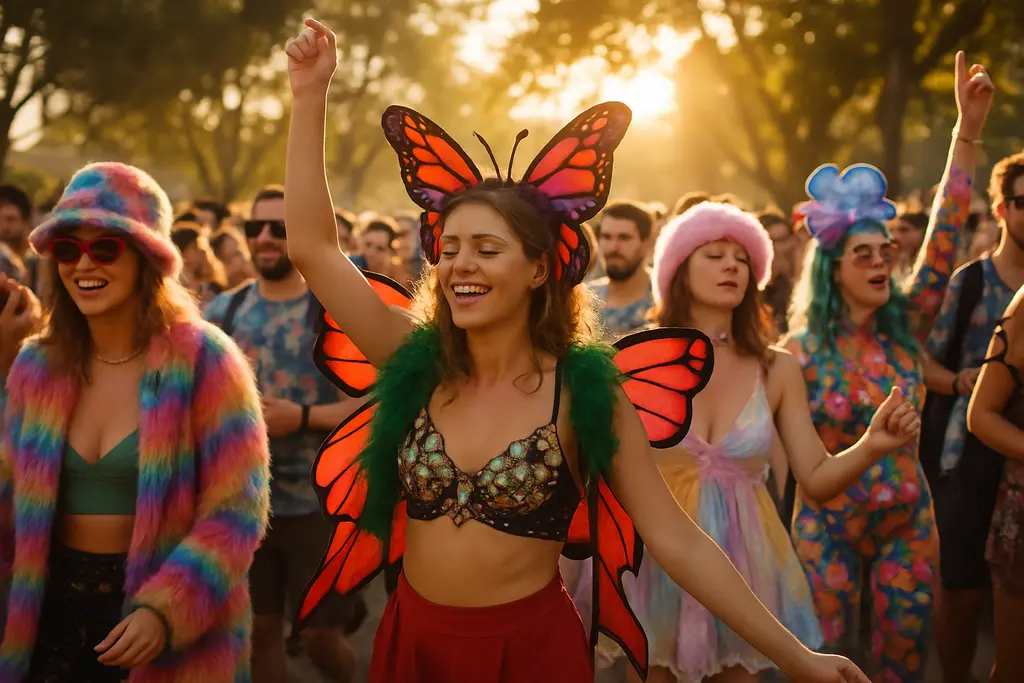
Portola Festival Costumes at the San Francisco music festival offered a clear case study in how rave dressing, fan culture, thrift practice, and weather-aware styling can meet without forming one single uniform. The fifth edition of Portola took place on September 26–27, 2026, and KQED’s photo coverage documented attendees using Powerpuff Girls-inspired color cues, leopard print, metallic accessories, faux fur, layered jewelry, animal-ear headbands, and character bags as visible styling tools KQED reported from Portola 2026. The result was not merely “festival wear” in a generic sense. It was a set of visual decisions shaped by music culture, concrete event grounds, Bay Area evening temperatures, and the social pleasure of being seen.
Why Portola Festival Costumes Read As A Style Index
Portola Festival Costumes And Character Signals
Character-inspired dressing was one of the more legible visual themes from September 26, 2026. The strongest examples were not literal replicas, at least in the documented street-style sense, but recognizable signals: color blocking, hair choices, exaggerated accessories, and references to figures such as Buttercup, Bubbles, and HIM. That matters for costume culture because fan dress often works through suggestion rather than full reproduction. A green-and-black palette, a blue bow, or a pointed color contrast can communicate a reference without requiring a head-to-toe copy.
This distinction is useful for DIY makers. Borrowing a mood, palette, or silhouette can be a more respectful and flexible way to participate in a shared visual language. For personal dress-up, the strongest character-adjacent looks usually keep enough distance to allow the wearer’s own body, comfort needs, and taste to stay visible. For sellers, rights clearance should be treated with care; a handmade item inspired by general color contrast is not the same as merchandise using protected names, artwork, or likenesses. This is not legal advice, but it is a practical caution for creator commerce.
Animal Print As Costume Texture
Leopard print, cow print, and other animal-pattern motifs carried a theatrical role at Portola. The research notes describe leopard overalls, ruffle shorts, and other spotted pieces at the 2026 event, while 2025 street-style reporting also pointed to animal prints as recurring choices. These patterns do not need elaborate construction to read as costume. A single animal-print garment can make a plain outfit feel performative, especially when paired with sunglasses, boots, metal jewelry, or a fuzzy bag.
Animal print also bridges several fashion codes at once. It can reference nightlife, camp, thrift-store styling, early-2000s revival, and faux-fur glamour. At Portola, its function seemed less about one fixed era and more about visual volume. On a crowded site, a spotted fabric can hold attention from a distance. For DIY dress-up, that means animal print works best when the pattern has room to speak. Pairing it with one solid base color, rather than several competing prints, can make the look easier to read in photographs and easier to wear for long hours.
Material Effects: Metallics, Mesh, And Black Layers
Silver Shine And Futuristic Styling
Metallic styling returned strongly in the 2026 coverage, with examples such as silver star outfits, open-shoulder tops, silver sunglasses, and other reflective accessories. This kind of sheen has a long relationship with dance-event fashion because it reacts well to stage light, flash photography, and movement. A silver accessory can act almost like a small prop: it catches light, frames the face, and creates an artificial, space-age surface against skin or black clothing.
For Portola Festival Costumes, metallics worked best when they were balanced with practical garments. Silver sunglasses, a foil-like top, or reflective trim can carry the futuristic theme without making the outfit hard to move in. This is especially relevant at a site where attendees walk between stages and stand for long sets. A reflective fabric with poor stretch may look striking for an hour, then become a problem. The strongest costume planning treats shine as one material effect, not as a reason to ignore fit.
Black Utility As A Nighttime Base
Black remained a strong styling base in the research notes, especially through cargo pants, mesh tops, oversized layers, and utility-leaning pieces. The appeal is practical as well as aesthetic. Black absorbs visual noise, lets accessories stand out, and makes layering easier after sunset. In Bay Area evening conditions, a hoodie, jacket, faux fur layer, or heavier pant can be part of the look rather than an afterthought.
That utility base also connects Portola with wider Bay Area festival dressing, though the Pier 80 setting gives it a harder edge than grass-field styling. Readers comparing this with cool-weather festival outfits may find useful parallels in utility festival fashion, especially around boots, denim, layers, and accessories built for shifting temperatures. The Portola version tends to lean more industrial and rave-coded: mesh, harness shapes, dark cargo pockets, and silver lenses rather than pastoral layers.
DIY Craft, Accessories, And Festival Identity
Handmade And Thrifted Signals
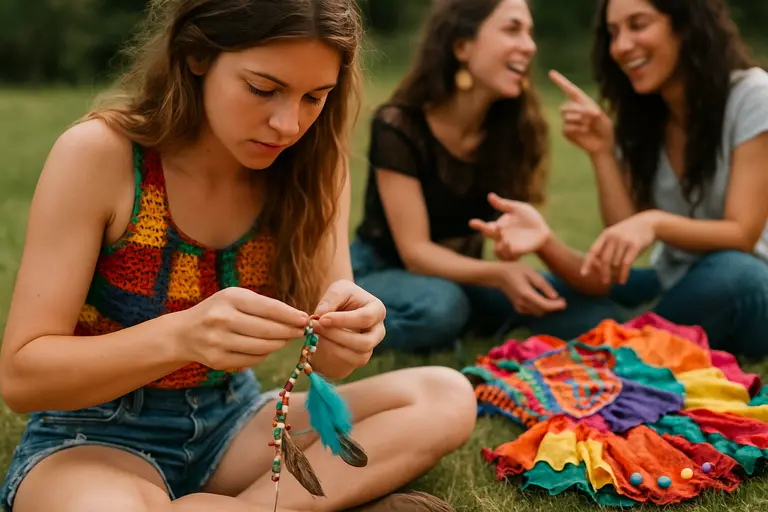
Portola style was not only brand-led. Research notes describe a visible presence of thrifted, upcycled, homemade, and locally sourced outfits, including San Francisco label examples such as matching flared halter-neck jumpsuits in cow-print or bandana print. That matters because festival fashion can easily become a cycle of single-use purchases. DIY and reuse do not automatically solve waste, but they can shift attention toward repair, personalization, and repeated wear.
A homemade costume does not have to be technically difficult to feel intentional. A thrifted black skirt can be altered with safety-pinned trim. A plain tank can be reworked with removable silver appliqué. A faux-fur hat can be paired with existing boots rather than a new full outfit. The most convincing DIY strategy is often subtraction: choose one handmade feature, then keep the rest wearable. This allows the craft to read clearly and lowers the chance that the wearer abandons parts of the costume halfway through the night.
Accessory Density And Social Readability
Accessories did much of the identity work. KQED’s 2026 coverage included layered necklaces, rave-style bracelets, fur hats, leather harnesses, animal-ear headbands, and fuzzy creature cross-body bags. These items are small, but they mark affiliation quickly. A bracelet stack can signal rave culture. A harness can shift a simple black outfit toward club styling. Animal ears or a plush bag can soften a severe silhouette. Readers exploring related pop-culture trends may find insights at Next Clues for additional cultural context.
The caution is that accessory density can collapse into clutter if every piece fights for attention. A strong Portola look often had one lead accessory group: headwear, jewelry, bag, or eyewear. For costume design, that hierarchy is worth copying. If the headpiece is the joke, keep the necklace quieter. If the bag is the character cue, let the clothing act as the frame. This approach respects the wearer’s comfort and gives the outfit a sharper read in motion.
Portola Festival Costumes And Fashion Showcase
What The 2025 Comparison Adds
The 2025 edition gives helpful context because it shows continuity rather than a one-day anomaly. The San Francisco Standard reported that Portola ran September 20–21, 2025, with about 45,000 attendees expected daily, and its street-style coverage observed animal prints, space buns, neon pops, clashing prints, metallic leggings, fringe, and whimsical accessories the San Francisco Standard noted in 2025. Against that record, the 2026 themes look less like isolated novelty and more like recurring tools in the festival’s visual grammar.
Portola Festival Costumes should therefore be read through repetition and adaptation. Animal print remained useful. Metallics kept their dance-floor value. Black utility wear continued to answer real comfort needs. Character cues and plush accessories added humor and social approachability. The most persuasive looks were not necessarily the most expensive or the most elaborate; they were the ones that made a clear aesthetic choice, survived the event setting, and left room for the wearer’s own presence. That is the lesson for DIY costume makers: start with one strong signal, build around movement and temperature, and avoid confusing homage with direct copying of protected art or characters.